Small Dog Dental Care — Why Chihuahuas, Yorkies and Toy Breeds Need More Protection Than You Think
Your small dog carries 42 adult teeth — the same number as a Great Dane — in a jaw a fraction of the size. The result is the most dangerous dental situation in the dog world: overcrowded teeth, thin bone, rapid disease progression, and a dog wired to hide the pain until it is impossible to ignore. This 2026 guide explains the science, the breed-specific risks, and the complete daily care routine that protects their tiny teeth for life.
Why Small Dogs Are Fundamentally Different — The Biology Behind Their Risk
The dental vulnerability of small breed dogs is not bad luck. It is a direct consequence of a specific biological mismatch: every domestic dog, regardless of size, develops exactly 42 adult teeth. A German Shepherd uses those 42 teeth in a jaw with adequate room. A Chihuahua tries to fit those same 42 teeth into a jaw a fraction of the volume.
Animal Dental Specialists of Stony Brook — a practice that sees the full spectrum of small breed dental disease — explains the result clearly: in small breeds, teeth rotate, overlap, and crowd against each other, creating tight crevices where plaque accumulates faster and is harder to remove with any brushing technique. The normal cleaning action of chewing is also less effective in crowded mouths, because food debris becomes trapped in intersections between rotated teeth rather than being expelled by normal jaw function.
The second biological factor is bone density. Small breeds naturally have thinner, less dense alveolar bone — the bone that holds tooth roots in the jaw. When periodontal bacteria begin attacking this bone through the inflammatory cycle of dental disease, the damage progresses faster and with less margin for error. A large breed dog may tolerate 30 percent bone loss around a tooth before it becomes mobile. A Chihuahua with the same percentage of bone loss may already be at risk of jaw fracture because there was simply less bone to begin with.
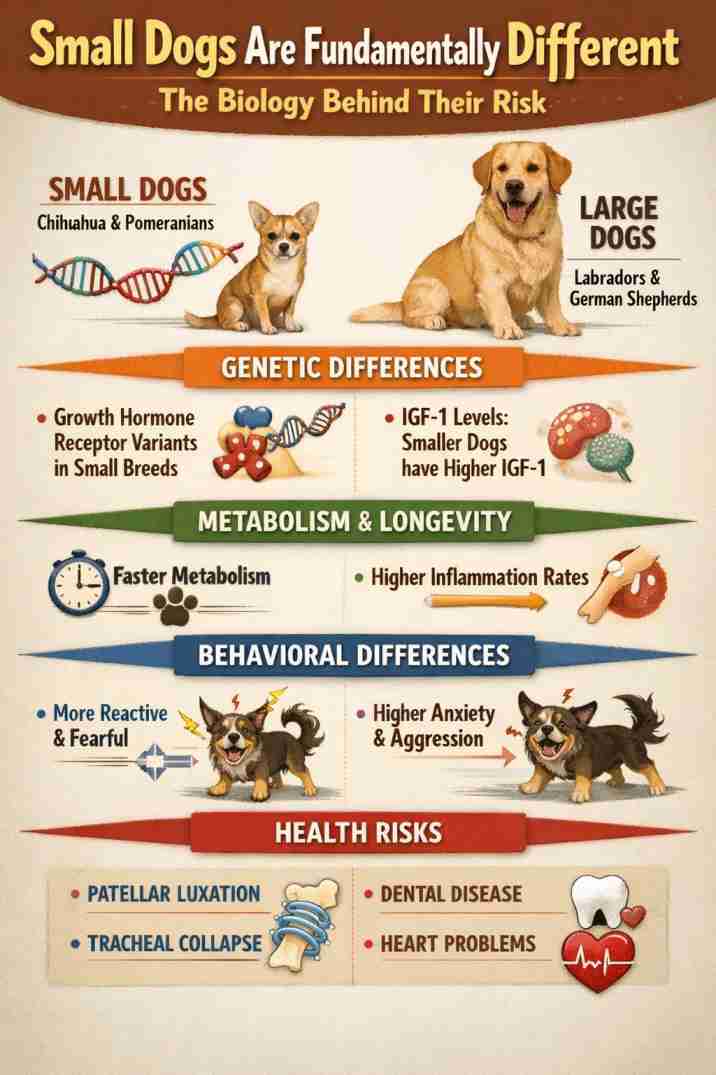
Swedencare USA's April 2026 small breed dental analysis summarises the consequence: small dogs are up to five times more likely to develop periodontal disease than large breeds. North Bay Veterinary Dentistry confirms that "by age three, most toy breeds already show signs of periodontal disease." The AVMA confirms periodontal disease is the most common dental condition in dogs — and in small breeds, it arrives years earlier and progresses years faster.
The most important thing to understand: Small dog dental disease is not a smaller version of large dog dental disease. It is a faster, more destructive, and more consequence-laden version of the same disease — with unique complications like jaw fractures and oronasal fistulas that are essentially exclusive to small breeds. Everything in their dental care must be more proactive, more frequent, and more consistent than the standard large-breed guidance.
Which Small Breeds Are at Highest Risk
While all small dogs face elevated dental disease risk compared to large breeds, certain breeds face compounding factors — jaw anatomy, genetic bone density issues, retained baby teeth — that place them at the very highest end of the risk spectrum.
5 Unique Dental Risks Only Small Dogs Face
Beyond faster-progressing standard periodontal disease, small dogs face several specific complications that are either rare or non-existent in large breeds. Every small dog owner should know these conditions exist — because each one is entirely preventable with proper care.
Spontaneous Jaw Fracture from Bone Loss
In small breeds with severe periodontal disease, bone loss can become so extensive that the jaw itself — particularly the lower mandible — becomes structurally compromised. Animal Dental Specialists confirms that in advanced cases in Chihuahuas and Toy Poodles, the bone surrounding the tooth roots may be so destroyed that normal chewing forces cause the jaw to fracture spontaneously. This is a veterinary emergency requiring surgical jaw repair. It is entirely preventable with early dental care. No large breed dog faces this risk at a comparable rate.
Oronasal Fistula
An oronasal fistula is an abnormal opening between the oral cavity and the nasal cavity. It occurs when advanced infection around the upper canine tooth destroys the thin bone separating the mouth from the nose. According to Animal Dental Specialists and the Royal Academy's veterinary dental guide for small breeds, this is disproportionately common in small dogs — particularly Dachshunds and Chihuahuas — because the bone between tooth root and nasal floor is thinner in a small jaw. Once formed, it requires specialised surgical flap repair. Symptoms include sneezing food or water, chronic nasal discharge, and persistent bad breath with a nasal quality. This is preventable with early upper canine periodontal care.
Retained Baby Teeth (Persistent Deciduous Teeth)
In healthy puppies, baby teeth fall out as adult teeth emerge — typically between 12 and 24 weeks. In many small breeds, baby teeth stubbornly persist alongside the emerging adult teeth, creating what Animal Dental Specialists calls a "double row of teeth." This immediately worsens crowding, forces adult teeth into abnormal positions, and creates additional plaque traps. If retained baby teeth are not extracted as soon as identified — ideally before 6 months — they cause permanent misalignment in adult teeth. This is why puppy dental health in small breeds deserves active attention from the first weeks of life, not the first year.
Chronic Ulcerative Paradental Stomatitis (CUPS)
CUPS is a painful inflammatory condition in which the oral mucosa develops contact ulcers wherever it touches a tooth surface covered in plaque. The Royal Academy of Veterinary Sciences' small breed dental guide identifies this as particularly common in Chihuahuas and Shih Tzus. Dogs with CUPS often have normal to excessive plaque accumulation but surprisingly little tartar — meaning they may look "clean" on casual inspection while experiencing significant oral pain. Treatment ranges from intensive home plaque control to full-mouth extraction in severe cases. Early and aggressive plaque control is the most effective prevention.
Hypothermia Risk During Anaesthesia
Very small dogs lose body heat under anaesthesia significantly faster than large dogs due to their higher surface-area-to-body-mass ratio. YorkieInfoCenter's veterinary guidance specifically recommends requesting a warming blanket for small dogs during dental procedures — this helps prevent hypothermia, which is a major cause of anaesthesia-related complications in toy breeds. Always mention your dog's small size and ask about temperature monitoring and warming protocols when scheduling any dental procedure.
Warning Signs of Dental Disease — What to Watch For and When
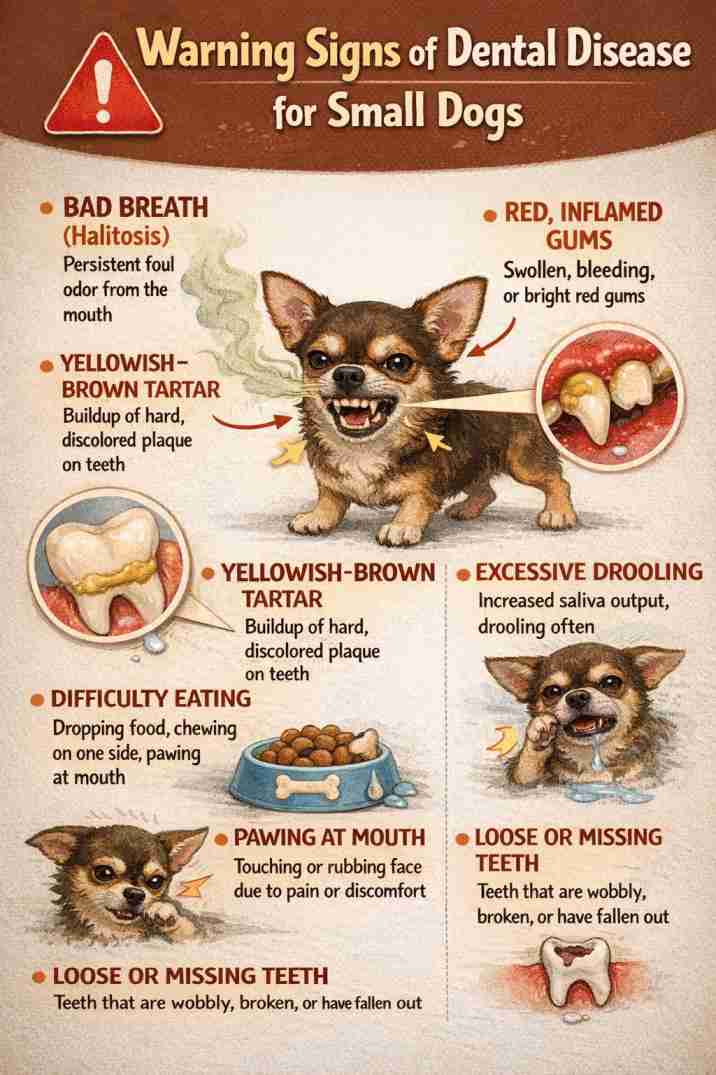
Because small dogs hide discomfort so effectively, warning signs often appear only after significant disease has already established. Knowing what to look for at each life stage gives you the best chance of catching problems early.
Baby teeth not falling out on schedule
All baby teeth should be shed by 6 months. If you see two rows of teeth — baby and adult in the same socket — retained deciduous teeth need immediate veterinary extraction to prevent permanent adult tooth misalignment. Check at every puppy vet visit.
Bad breath developing, early tartar on upper back teeth
Most small breed owners dismiss this as "normal." It is not. Persistent bad breath at age one or two is early warning that plaque is accumulating faster than it is being removed. Visible yellow deposits on upper canines confirm tartar has formed. First professional cleaning with full-mouth X-rays recommended by age one per AAHA.
Red gum line, heavy tartar, possible eating hesitation
Most small breeds without proactive care show Stage 2 to 3 disease in this age range. Red gum edges, heavier tartar, and the first signs of changed eating behaviour indicate significant disease is already present. Biannual professional cleanings strongly recommended from this point.
Gum recession, possible tooth mobility, behaviour changes
Gum recession — teeth appearing longer as gums pull away from roots — indicates established bone loss. Tooth mobility indicates advanced disease. Irritability, reluctance to be touched near the face, and pawing at the mouth reflect significant chronic pain. Urgent veterinary dental evaluation with X-rays required.
Facial swelling, loose or missing teeth, food refusal
Facial swelling — particularly below the eye — indicates abscess or spreading infection. Missing adult teeth means disease destroyed supporting bone completely. Any food refusal in a senior small breed is a dental emergency until proven otherwise. Contact your vet today if you see these signs.
Persistent bad breath
Consistently offensive at conversational distance — not just after eating
Visible tartar on upper back teeth
Yellow or brown deposits along gum line of upper molars and canines
Red gum edge
Dark pink or red line where gum meets tooth — healthy gums are pale pink and firm
Bleeding when gums touched
Any bleeding on gentle touch indicates active gingivitis — the last reversible stage
Changed eating behaviour
Dropping food, one-sided chewing, eating more slowly, avoiding hard kibble
Pawing at mouth or face rubbing
Rubbing face on carpet or furniture — attempting to relieve acute oral discomfort
Visible gum recession
Teeth look longer — gum has pulled away from root — indicates bone loss
Facial swelling or missing teeth
Swelling below eye or along jaw, or adult teeth missing — contact vet today
The Monthly Home Mouth Check for Small Dogs
A monthly 60-second mouth examination is one of the most underutilised tools in small breed dental care. Small dogs can go from early gingivitis to Stage 3 disease faster than large breeds — which makes a monthly check clinically meaningful.
Position in good natural light near a window
Choose a calm moment. Never force the examination — if your dog resists, stop and try again tomorrow. Forced examination in a resistant dog gives inaccurate information and damages trust for future checks.
Smell first at arm's length
Before lifting the lip, note the breath at arm's length. Mild odour up very close is acceptable. Consistently offensive breath at normal distance is a clinical signal regardless of what the teeth look like.
Lift the upper lip and check the gum line colour
Look where the gum meets the upper back teeth and canines. Healthy: pale pink, firm, clean line against the tooth. Concerning: red or purple line, swelling, recession, visible roots.
Check for tartar on upper back teeth — both sides
Look at outer surfaces of upper molars and premolars. Any yellow, tan, or brown deposit is tartar. Run a clean fingertip along the surface: smooth means clean, rough or gritty means tartar is present. Check both sides — deposits are often asymmetrical in small breeds.
Photograph monthly and compare
A quick photo of each side of the upper back teeth every month creates a comparison baseline. Changes between months are much easier to spot than changes remembered in isolation. Share concerning changes with your vet at the next visit or call sooner.
The Complete Daily Dental Care Routine for Small Dogs
Because small breeds accumulate plaque faster and have less margin for error due to thinner bone, their daily routine needs to be more consistent than for large breeds. The following routine, applied daily, gives small dogs the best achievable at-home protection.
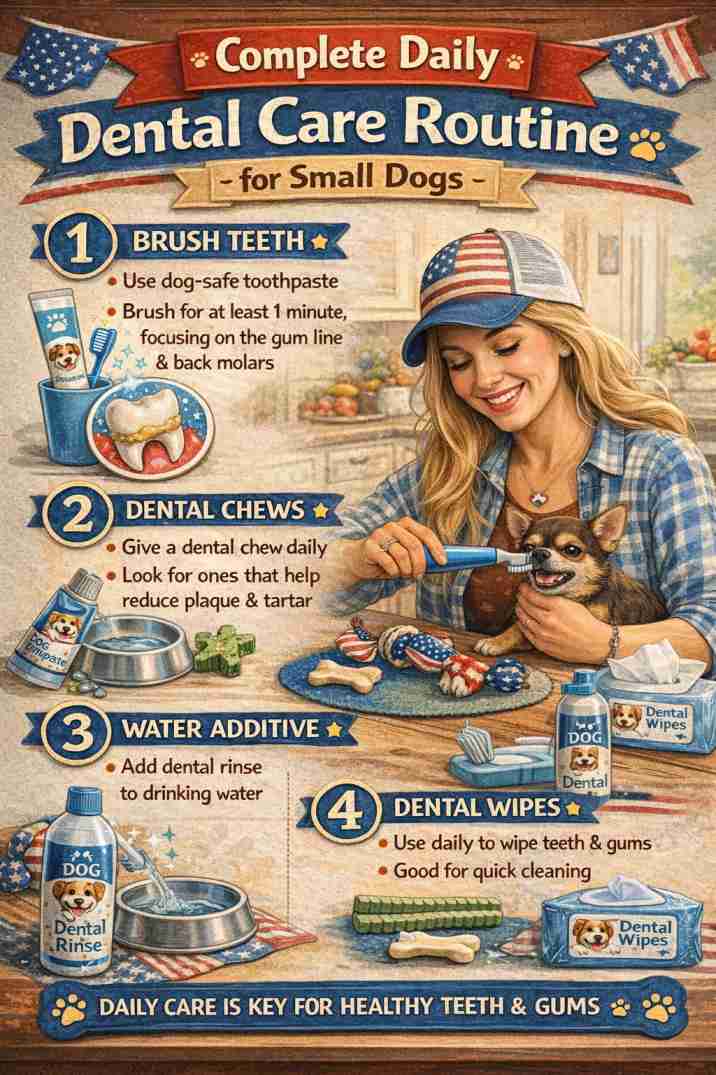
Daily brushing — 60 seconds with a finger brush and enzymatic toothpaste
Use a finger brush or small-headed dog toothbrush — standard sizes are too large for small mouths. Use VOHC-approved enzymatic toothpaste only: Virbac C.E.T. (VOHC 2026, plaque and tartar) or Petsmile Professional (VOHC, plaque inhibition). Swedencare USA's 2026 guide confirms plaque begins mineralising into tartar within 24 to 48 hours — so daily brushing is the minimum to interrupt this cycle. Angle the brush at 45 degrees toward the gum line and focus on outer surfaces of upper back teeth.
🌟 Small breed: use finger brush first to navigate tight spacesOne VOHC-approved dental chew daily — weight-matched, not just "small"
Size selection is especially critical for small breeds. Give a chew weight-matched to your dog — not "small" in general terms but specifically matched to the product's weight guide. Greenies Original Petite (5–15 lbs) and Teenie (under 10 lbs), WHIMZEES BRUSHZEES Small, and Virbac C.E.T. VEGGIEDENT Flex Small are all VOHC-approved options. The thumbnail test applies: the chew should yield to your thumbnail — anything harder risks tooth fracture, which is especially serious in small breeds with fragile teeth.
🌟 Small breed: always check weight range — not just "small" on the packageWater additive in every bowl refill — tasteless and odourless
Add Oxyfresh or comparable tasteless water additive to every fresh bowl refill — one capful per 32oz of water. For small dogs who resist brushing, this is one of the few methods requiring no cooperation at all. It neutralises odour-causing bacteria every time your dog drinks, providing passive ongoing protection between brushings. Use it regardless of how well brushing is going — the additive works on different bacterial targets and provides complementary daily protection.
🌟 Completely safe for small dogs who drink lower volumesNever give hard chews, bones, or antlers to small dogs
Cornell University College of Veterinary Medicine warns that chewing hard objects causes tooth fractures — and this risk is amplified in small breeds whose teeth are smaller and more brittle. Bones, antlers, hooves, hard nylon toys, and ice cubes all fail the thumbnail test. A fractured tooth in a small dog often requires extraction — a significant oral surgery in a tiny jaw. Provide only soft-to-medium rubber toys (KONG-style) or purpose-made small breed chews that pass the thumbnail test.
🌟 Small breed: tooth fracture risk higher due to smaller, more brittle teethWeekly dental wipe or gauze for crowding-related plaque traps
Even with daily brushing, the tight interdental spaces in a crowded small breed mouth are difficult to reach with bristles. Once a week, use a dental wipe or clean gauze wrapped around your finger to wipe between teeth in the areas where crowding creates additional plaque traps. This is not a substitute for brushing but directly addresses the crowding problem that is specific to small breeds and makes their dental care more demanding than in large dogs.
🌟 Small breed specific: crowding creates spaces brushes cannot fully reachThe 5-Day Brushing Introduction for Resistant Small Dogs
Small dogs are often the most resistant brushing candidates — their size makes restraint difficult, and their personality often includes strong opinions about mouth touching. This approach, endorsed by Cornell University College of Veterinary Medicine, builds acceptance gradually using positive reinforcement over five days rather than forcing the issue and creating permanent resistance.
Taste test — toothpaste only, no brush
Dip a clean finger in enzymatic toothpaste and let your dog lick it off. Treat and praise generously. 30 seconds. Goal: positive association with the toothpaste. End on success — never force.
Finger on lips and gums — toothpaste on finger
Apply toothpaste to your finger. Gently rub the outside of the lips, then briefly touch the gum surface. Treat and praise. 45 seconds. Goal: comfort with mouth contact.
Introduce the finger brush — just the front teeth
Slide finger brush over your index finger with toothpaste. Gently brush just the front upper teeth for 15 to 20 seconds. Do not force the back. Treat and praise immediately. Under 1 minute total.
Front teeth and one side of upper back teeth
Extend to include one side of upper back teeth — the priority area for plaque accumulation. Work quickly and confidently. 30 to 45 seconds total. Praise and reward throughout the process, not just at the end.
Full mouth — 60 seconds angled toward gum line
Brush all reachable tooth surfaces at 45 degrees toward the gum line. Focus time on upper back teeth. 60 seconds total. Generous treat and celebration. From this day, brushing becomes the daily routine at the same time each day.
🛒 Our 2026 Top Picks for Small Breed Dental Care
Professional Cleaning Schedule for Small Dogs — Often Biannual, Never Optional
3 Dangerous Myths Small Dog Owners Believe
Frequently Asked Questions
Small dogs have the same 42 adult teeth as large dogs but far less jaw space to fit them in. Animal Dental Specialists confirms that in small breeds, teeth rotate, overlap, and crowd against each other, creating tight crevices where plaque accumulates faster and is harder to remove. Small breeds also have thinner, less dense alveolar bone, so periodontal bone loss progresses faster and with more severe consequences — including jaw fractures in advanced cases. Swedencare USA's 2026 research notes small dogs are up to 5 times more likely to develop periodontal disease than large breeds. By age three, most toy breeds already show clinical signs of dental disease.
AAHA recommends small dogs have their first professional dental cleaning with full-mouth dental X-rays by age one — one year earlier than the recommendation for large breeds. After that, AAHA states small dogs and certain breeds may need cleanings more frequently than once a year. For highest-risk breeds like Chihuahuas and Yorkshire Terriers, specialist veterinary dental practices and the Chihuahua Club of America recommend professional cleaning every six months. Dogs with excellent daily home care may extend the interval based on their vet's individual assessment at each wellness exam.
Early signs include persistent bad breath detectable at normal conversational distance, visible yellow or brown tartar buildup along the gum line of upper back teeth, red or swollen gum edges, and bleeding on gentle touch. As disease progresses: reluctance to chew hard food, dropping food from the mouth, chewing only on one side, pawing at the mouth, and facial swelling. Because small dogs hide discomfort effectively, monthly home mouth checks are essential to catch changes between vet visits — waiting for obvious symptoms means waiting until the disease is significantly advanced.
For small and toy breed dogs, use a finger brush or a small-headed soft-bristled toothbrush specifically designed for toy breeds — standard dog toothbrush heads are too large to manoeuvre properly in a small mouth. Finger brushes give better control in a tight oral cavity and are often better tolerated during the desensitisation process. Always use dog-specific enzymatic toothpaste — never human toothpaste, which contains xylitol or fluoride, both toxic to dogs. Cornell University College of Veterinary Medicine recommends soft bristles specifically to avoid gum irritation during brushing.
In the most severe cases of advanced periodontal disease in small breeds, jaw fractures can occur. This is not a theoretical risk. Animal Dental Specialists confirms that in Chihuahuas and Toy Poodles with advanced bone loss, the mandible can become so structurally weakened that normal chewing forces cause fracture — a dental emergency requiring surgical jaw repair. This develops because small breeds have thinner alveolar bone that is less resistant to the bone-dissolving process of advanced periodontal disease. It is entirely preventable — this complication occurs in dogs whose dental disease was allowed to reach Stage 4 without treatment.
For dogs under 10 lbs, use VOHC-approved chews in weight-matched sizes: Greenies Original Teenie (under 10 lbs) and Petite (5–15 lbs), WHIMZEES BRUSHZEES Small (grain-free, suitable for sensitive dogs). Apply the thumbnail test to any chew — if you cannot dent it with your thumbnail, it is too hard for small dog teeth and risks tooth fracture. Never give antlers, real bones, hard nylon toys, or ice cubes to small dogs regardless of labeling — tooth fracture risk is significantly elevated in small breeds due to smaller, more brittle teeth and thinner enamel.
The Bottom Line on Small Dog Dental Care — April 2026
If there is one thing this guide establishes, it is this: small dog dental care is not a smaller version of large dog dental care. It is a more urgent, more frequent, and more consequential undertaking — because the biology of small breeds combines overcrowded teeth, thin bone, and rapid disease progression in a way that has no parallel in large breeds.
Starting at age one. Daily brushing with a finger brush and enzymatic toothpaste. One VOHC-approved small-breed chew daily. Water additive in every bowl refill. Professional cleaning every six to twelve months with full-mouth X-rays. Monthly home mouth check with a photo. These are not optional extras — they are the minimum that keeps a small dog's mouth healthy and their jaw structurally intact.
The conditions that small breed owners dread — jaw fractures, oronasal fistulas, tooth loss at age four — are not inevitable. They are entirely preventable. The difference between a Chihuahua who loses teeth at four and one who still has a full mouth at fourteen is almost always the dental care routine established in puppyhood and maintained consistently ever after.