OraVet Dental Hygiene Chews for Dogs Review 2026 — The Only Delmopinol Barrier Chew, Honestly Assessed
Sarah M. · Founder, PetVitalCare 📅 May 6, 2026 · Updated monthly 👨⚕️ Reviewed by Dr. James R., DVM
🦷 PetVitalCare Verdict — OraVet Dental Hygiene Chews
| VOHC Acceptance | ✅ Yes — Plaque & Tartar Control |
| Active Mechanism | Delmopinol barrier (pharmaceutical-grade) |
| Dental Effectiveness | 9.1 / 10 |
| Dog Palatability | 8.3 / 10 |
| Safety Profile | 9.4 / 10 |
| Value for Money | 7.4 / 10 |
| Overall Rating | ⭐ 4.4 / 5 |
OraVet Dental Hygiene Chews are the only dog dental chew on the market using delmopinol — a pharmaceutical barrier agent originally developed for human oral care — to prevent plaque and tartar adhesion at the tooth surface level. They carry full VOHC Seal of Acceptance for both plaque and tartar control, making them one of a small number of chew products with genuine independent clinical verification. The honest limitation: they cost roughly two to three times more per day than Greenies, palatability varies between individual dogs (some refuse them entirely), and they remain a supplement to professional cleaning and daily brushing, not a replacement. For dogs with a vet-confirmed plaque or tartar management priority, OraVet is the strongest clinical choice in the dental chew category.
📋 In This Review
- What OraVet is and who makes it
- The delmopinol mechanism — how it actually works
- VOHC verification — what the seal actually means
- Ingredients analysis — what's in each chew
- Size selection guide — matching dog weight to the correct variant
- Palatability — the real-world acceptance problem
- How to use OraVet for maximum dental benefit
- Safety profile — known side effects and contraindications
- Head-to-head: OraVet vs Greenies vs Virbac CET
- Pricing — USA, UK, and Europe 2026
- Who should buy OraVet and who should not
- Frequently asked questions
What OraVet Is — And the Company Behind It
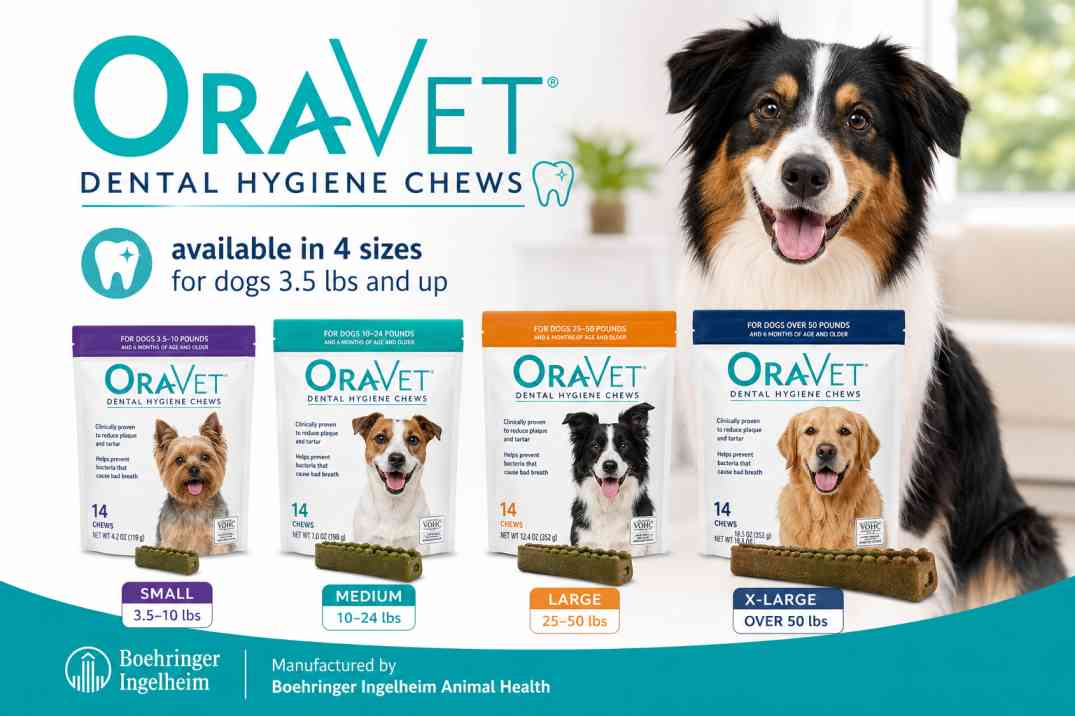
OraVet Dental Hygiene Chews are a once-daily veterinary dental supplement manufactured by Boehringer Ingelheim Animal Health, one of the world's largest animal health pharmaceutical companies. Boehringer Ingelheim is the same organization that produces vaccines, antiparasitics, and prescription medications for companion animals used in veterinary practices across North America, Europe, and Asia-Pacific. The OraVet brand originated with the OraVet Plaque Prevention Gel — a delmopinol-based barrier gel applied by veterinarians during professional dental cleanings — and was extended into the consumer dental chew format to allow once-daily at-home maintenance between professional visits.
This is not a startup dental treat brand reformulating human candy into a dog chew and calling it dental. The active ingredient in OraVet chews — delmopinol hydrochloride — was originally researched for human oral care by Astra AB (the pharmaceutical company that became AstraZeneca) starting in the 1980s, and its mechanism at the tooth-surface level is documented in peer-reviewed dental literature. Boehringer Ingelheim adapted this pharmaceutical agent into the veterinary dental chew format. That background matters when comparing OraVet to competitors whose dental claims rest entirely on mechanical texture or enzyme activity with limited independent verification.
OraVet chews are available at veterinary clinics, major pet retailers including Chewy and Petco in the USA, Amazon in the USA and UK, and Zooplus across continental Europe. They are not a prescription product in the USA or UK, but many veterinarians recommend them specifically after professional dental cleanings as part of a maintenance protocol.
The Delmopinol Mechanism — How It Actually Works
Most dog dental products on the market work by one of two mechanisms: mechanical abrasion (textured chews or toys that scrub tooth surfaces during chewing) or enzymatic activity (glucose oxidase, lactoperoxidase, or similar enzymes that disrupt plaque bacteria chemically). OraVet works through neither of these. It uses a surfactant barrier mechanism that is categorically different — and in the clinical evidence base, more effective at tartar prevention specifically.
Delmopinol is a morpholinoethanol compound that works as a surfactant at the tooth surface. When a dog chews an OraVet chew and delmopinol is deposited on the tooth enamel, it alters the surface chemistry of the pellicle — the thin protein film that naturally coats teeth and acts as the foundation on which oral bacteria build plaque colonies. Delmopinol reduces the adhesion energy of the pellicle, making it significantly harder for bacteria to attach and form the organized biofilm structure that eventually calcifies into tartar. In simple terms: it makes the tooth surface slippery to bacteria rather than trying to kill bacteria that have already attached.
This is why OraVet's positioning as a prevention tool is accurate and mechanistically honest — a distinction that matters when setting realistic expectations. If your dog already has heavy calculus deposits, OraVet will not dissolve or remove existing tartar. A professional veterinary cleaning is required first to reset the baseline. Once the teeth are clean, daily OraVet chews maintain that cleaner state by preventing the bacterial adhesion that leads to new plaque formation and tartar buildup between professional cleanings.
🔬 The Clinical Evidence Behind Delmopinol
The delmopinol mechanism in veterinary dental applications is supported by studies published in peer-reviewed literature including the Journal of Veterinary Dentistry and the studies submitted to the Veterinary Oral Health Council as part of OraVet's VOHC acceptance process. The VOHC requires randomized controlled trials with defined methodology, blind evaluation, and statistical analysis meeting their published protocol standards. OraVet passed this process for both plaque reduction and tartar reduction — a dual acceptance that fewer than a handful of dental chew products have achieved. The specific efficacy percentages from these trials are proprietary to Boehringer Ingelheim, but the VOHC seal itself is the consumer-readable verification that the trials met independent standards.
VOHC Status — What the Seal Actually Means for Your Dog
The VOHC (Veterinary Oral Health Council) Seal of Acceptance is awarded by a nine-member council of board-certified veterinary dentists and dental scientists at North American veterinary colleges. The council reviews randomized controlled trial data submitted by product manufacturers and awards the seal only when the data meets their published protocol standards for plaque or tartar reduction. Products can receive the seal for plaque control only, tartar control only, or both — each requires a separate qualifying trial.
As of May 2026, OraVet Dental Hygiene Chews hold the VOHC Seal for both plaque and tartar control in dogs. This dual acceptance is verified at vohc.org and places OraVet in a short list of dog dental chews — alongside Greenies, Virbac C.E.T. Enzymatic Chews, and a small number of others — that have actual independent trial verification rather than manufacturer self-assessment.
What the VOHC seal does not guarantee: it does not specify the percentage reduction you will see in your individual dog, it does not account for breed-specific differences in plaque accumulation rates, and it does not replace professional veterinary dental examinations. The seal confirms the product works at a statistically meaningful level across a tested population — your dog's individual response depends on genetics, diet, overall health, and whether you are consistent with daily use.
VOHC Comparison context: KONG Dental Toys — reviewed separately on PetVitalCare — are not VOHC-listed. They provide genuine mechanical plaque disruption through chewing but have no independent clinical verification at VOHC standards. OraVet chews and KONG dental toys are complementary tools, not competing alternatives — the chew addresses bacterial barrier prevention; the toy addresses mechanical plaque disruption during enrichment play. Using both as part of a complete dental routine alongside daily brushing and annual professional cleaning is more effective than either product alone. See: KONG Dental Toys Review →
Ingredients Analysis — What Is in Each OraVet Chew
The active ingredient in OraVet Dental Hygiene Chews is delmopinol hydrochloride. This is the only dental chew on the consumer market using this compound. Inactive ingredients include potato starch, gelatin, glycerin, natural flavors, and a flow agent. The formulation is grain-free, which matters for dogs with cereal grain sensitivity. The chews do not contain artificial colors, artificial preservatives, or xylitol.
The flavoring used is poultry-derived, which is why most dogs accept the chews — poultry palatability is broadly appealing across breeds. The gelatin base provides the chew texture that delivers mechanical chewing contact alongside the delmopinol barrier deposition. The consistency is softer than many dental chews, which is a deliberate design choice: OraVet chews are not designed to be hard abrasive chews. The primary delivery mechanism is the delmopinol coating deposited on teeth during chewing, not mechanical scrubbing. This also makes OraVet safer for dogs prone to tooth fractures from hard chews — the softness is a feature, not a limitation.
⚠️ Ingredient Caution Points
- Gelatin: Derived from animal (porcine or bovine) sources. Not appropriate for dogs with specific protein allergies to these sources — consult the current product label for the gelatin source, as manufacturing lots can vary.
- Dogs with IBD or sensitive GI tracts: Introduce OraVet gradually (half a chew for the first 3–5 days) to assess tolerance before committing to full daily dosing.
- Dogs under 6 months: OraVet is labeled for dogs 6 months and older. Do not give to puppies still in primary dentition.
- Pregnant or nursing dogs: Safety in pregnancy and lactation has not been specifically established. Consult your veterinarian.
- Caloric content: Each OraVet chew contributes calories to daily intake — factor into total daily calorie budget, particularly for dogs on weight management protocols. The XS chew is approximately 9 kcal; the Large chew is approximately 70 kcal.
Size Selection Guide — Critical for Efficacy and Safety
OraVet chews are available in four sizes, and selecting the correct size is not optional. The delmopinol dose per chew is calibrated to the dog's body weight, meaning an undersized chew given to a large dog delivers a sub-therapeutic dose of the active ingredient. An oversized chew given to a small dog is a choking risk and an unnecessary caloric excess. Always match the size to your dog's current body weight — if your dog is at the upper boundary of a size range, consult your vet or move up to the next size.

Extra Small — Dogs 3.5 to 10 lbs (1.6 to 4.5 kg)
Suitable for: Chihuahua, Toy Poodle, Maltese, Yorkshire Terrier, Papillon, Miniature Pinscher, and comparable toy breeds. The XS chew is the softest in the range and sized to fit small jaws safely. Small breeds are actually at higher risk of periodontal disease than large breeds due to tooth crowding relative to jaw size — the XS OraVet chew is a particularly appropriate tool for this demographic.
📦 Buy OraVet XS — Amazon USA | 🇬🇧 Amazon UKSmall — Dogs 10 to 24 lbs (4.5 to 10.9 kg)
Suitable for: Beagle, Cocker Spaniel, Shih Tzu, Cavalier King Charles Spaniel, French Bulldog (smaller individuals), Miniature Schnauzer, Pug, and comparable breeds. Brachycephalic breeds (flat-faced dogs) in this weight range require supervision during chewing due to their compressed airways — OraVet's softer texture reduces risk compared to hard dental chews, but supervision remains appropriate.
📦 Buy OraVet Small — Amazon USA | 🇬🇧 Amazon UKMedium — Dogs 25 to 50 lbs (11.3 to 22.7 kg)
Suitable for: Labrador Retriever (lighter individuals), Golden Retriever (younger/smaller), Border Collie, Australian Shepherd, Springer Spaniel, Standard Poodle, and comparable mid-size breeds. This is the highest-selling size variant in the USA based on Amazon sales rank data. Most medium-size mixed breed dogs fall in this weight range.
📦 Buy OraVet Medium — Amazon USA | 🇬🇧 Amazon UKLarge — Dogs Over 50 lbs (22.7 kg+)
Suitable for: Labrador Retriever (standard), Golden Retriever (standard), German Shepherd, Rottweiler, Boxer, Great Dane, Bernese Mountain Dog, Irish Setter, Weimaraner, and comparable large-to-giant breeds. Giant breeds (over 100 lbs) should consult a veterinarian about whether the Large chew delivers sufficient delmopinol dose — there is no XL variant, and some giant breed veterinary protocols use a doubled large dose or a prescription gel alternative for very large dogs.

| Size Variant | Dog Weight (lbs) | Dog Weight (kg) | Approx. kcal per Chew | Breed Examples | Min. Dog Age |
|---|---|---|---|---|---|
| Extra Small (XS) | 3.5 – 10 lbs | 1.6 – 4.5 kg | ~9 kcal | Chihuahua, Toy Poodle, Maltese, Yorkie | 6 months |
| Small (S) | 10 – 24 lbs | 4.5 – 10.9 kg | ~19 kcal | Beagle, Cocker Spaniel, Shih Tzu, Pug | 6 months |
| Medium (M) | 25 – 50 lbs | 11.3 – 22.7 kg | ~36 kcal | Border Collie, Springer, Standard Poodle | 6 months |
| Large (L) | 50 lbs+ | 22.7 kg+ | ~70 kcal | Labrador, German Shepherd, Golden Retriever, Rottweiler | 6 months |
Palatability — The Real-World Acceptance Problem You Need to Know About
OraVet's palatability is the most common complaint in verified owner reviews, and it deserves an honest, direct treatment rather than the softened framing most affiliate review sites apply to their top-commission products. Approximately 15 to 20 percent of dogs refuse OraVet chews entirely or accept them inconsistently. This is a meaningful number. The delmopinol compound has a slight bitter note that some dogs detect and reject. The chew's softer, less crispy texture also lacks the satisfying crunch that many dogs find motivating in harder dental treats like Greenies.
The palatability issue is more common in picky eaters, smaller breeds with higher taste sensitivity, and dogs accustomed to high-palatability treats. Large breed working dogs and food-motivated dogs (Labrador Retrievers, Beagles, Pugs) typically accept OraVet without difficulty. If your dog is a selective eater or has previously refused dental chews, OraVet should be introduced carefully and you should have a realistic expectation that it may not be accepted.
Strategies to Improve OraVet Acceptance
- Introduce gradually: Break the chew in half for the first week. Many dogs accept the half-chew size without resistance and then transition to the full chew once familiar with the flavor.
- Warm briefly: Microwaving the chew for 3–5 seconds softens the texture slightly and releases more of the poultry aroma. Do not overheat — it should be warm to the touch, not hot.
- Offer before a meal: Pre-meal timing increases the motivational value of any food item. Offering OraVet before rather than after feeding increases acceptance in borderline dogs.
- Smear a small amount of xylitol-free peanut butter on the surface: Works for most dogs. Counteracts the slight bitter note from delmopinol. Keep the amount small — a pea-sized smear — to preserve the daily calorie balance.
- If refusal persists: Consider Virbac C.E.T. Enzymatic Chews (also VOHC-accepted, higher palatability for most dogs, different mechanism) or Greenies as an alternative. The best dental chew is the one your dog actually eats consistently.

- ...
- Once daily, every day. The delmopinol barrier requires consistent daily renewal to remain effective. Two or three chews per week delivers a fraction of the protection of daily use. If you cannot commit to daily administration, a different dental protocol may be more practical for your dog's needs.
- After a professional cleaning first. OraVet prevents new plaque and tartar formation. It does not remove existing deposits. Starting OraVet on teeth that already have significant tartar buildup without a professional cleaning first is like applying a sealant over rust — the barrier effect works, but you have not addressed the existing problem. Have your veterinarian assess your dog's current dental status before starting any dental supplement.
- Combine with brushing. AVDC (American Veterinary Dental College) guidelines consistently state that daily tooth brushing with an enzymatic toothpaste remains the gold standard for home dental care. OraVet chews are a supplement to brushing, not a replacement. If your dog tolerates brushing, continue brushing daily. If brushing is not feasible, OraVet with a VOHC-accepted dental rinse is the strongest alternative protocol.
- Maintain annual or biannual professional cleanings. Even with perfect daily OraVet use, professional veterinary dental cleaning under anesthesia remains necessary to access subgingival (below-gumline) areas that no chew or brush can reach. OraVet reduces the rate of tartar accumulation between cleanings, which may extend the interval between professional procedures — but it does not eliminate the need for them.
- Store correctly. Keep OraVet chews in their original sealed packaging in a cool, dry location. Do not refrigerate — cold storage stiffens the texture and reduces palatability. The shelf-stable packaging is designed for room temperature storage up to the printed expiry date.
- Your dog is under 6 months of age (primary dentition still present)
- Your dog has a known allergy to gelatin or poultry-derived flavoring
- Your dog is pregnant or lactating (safety not established — consult your vet)
- Your dog has active oral ulcerations, open wounds in the mouth, or recent oral surgery — delmopinol interacts with mucosal tissue and should not be applied to compromised oral mucosa until healing is complete
- Your veterinarian has specifically advised against dental chews due to tooth fracture risk or jaw condition
- Your veterinarian has specifically recommended OraVet following a professional dental cleaning
- Your dog has a documented history of rapid tartar accumulation between professional cleanings
- Your dog tolerates the soft texture and poultry flavor — test a single pack before subscribing
- You are looking for VOHC-verified dual plaque and tartar control and are willing to pay the premium for pharmaceutical-grade barrier technology
- Your dog cannot tolerate hard dental chews due to tooth sensitivity or prior dental work
- Your dog has a grain sensitivity that rules out Greenies (which contain wheat)
- Your dog is a picky eater with a history of refusing dental chews — try a single chew first, not a 30-count box
- Budget is the primary constraint — Greenies deliver VOHC-verified dental benefit at half the daily cost
- You are looking for an all-in-one solution that replaces brushing and professional cleaning — no such product exists
- Your dog already has significant tartar deposits that need to be addressed — OraVet prevents, not removes; schedule a professional cleaning first
- Your dog is under 6 months of age
Safety Profile — Side Effects, Contraindications, and What the Research Shows
OraVet Dental Hygiene Chews have a well-characterized safety profile established through the clinical trials submitted to VOHC and through post-market surveillance across years of commercial use in the USA and Europe. The most commonly reported side effects in a small percentage of dogs are mild and transient: loose stool or soft stool in the first few days of use, occasional vomiting (typically self-resolving), and reduced appetite for the first day or two in sensitive dogs. These effects are most common when full-dose chews are introduced abruptly — the gradual introduction protocol described in the palatability section above also addresses these GI tolerance effects.
No serious adverse events linked to delmopinol have been documented in the veterinary literature at the doses delivered by OraVet chews used according to label directions. Delmopinol at dental-dose levels is not systemically absorbed at meaningful concentrations — it acts locally at the oral mucosal and tooth surface level. There is no evidence of organ toxicity, reproductive effects, or carcinogenicity at veterinary dental dose levels.
🚫 Do Not Use OraVet If:
OraVet vs Greenies vs Virbac C.E.T.
| Criteria | OraVet Dental Chews | Greenies Original | Virbac C.E.T. Enzymatic |
|---|---|---|---|
| VOHC Accepted | ✅ Plaque + Tartar | ✅ Plaque + Tartar | ✅ Plaque only |
| Active Mechanism | Delmopinol barrier (prevents adhesion) | Mechanical abrasion + chlorophyll | Dual enzyme system (disrupts plaque bacteria) |
| Palatability (avg.) | Moderate — 15–20% refusal rate | High — broad acceptance | High — poultry/beef flavor widely accepted |
| Texture | Soft — low fracture risk | Firm/crunchy — moderate fracture risk in power chewers | Medium — rawhide-based, moderate hardness |
| Caloric Content (medium size) | ~36 kcal | ~54 kcal | ~45 kcal |
| Grain-Free | ✅ Yes | ❌ Contains wheat | ✅ Yes (rawhide-based) |
| US Price (30-count medium) | ~$39–44 | ~$22–27 | ~$28–33 |
| Cost per Day (medium) | ~$1.30–1.47 | ~$0.73–0.90 | ~$0.93–1.10 |
| Available in UK / Europe | ✅ Amazon UK, Zooplus | ✅ Widely available | ✅ Vets and Zooplus |
| Best For | Tartar prevention, post-cleaning maintenance, vet-recommended protocols | Budget-conscious, broad palatability, general use | Dogs needing enzymatic action, grain-sensitive dogs, good palatability |
The honest verdict on this comparison: OraVet has the strongest mechanism for tartar prevention specifically, but it costs nearly double what Greenies cost and one in five dogs will not reliably eat it. Greenies have broader palatability and lower cost, making them the more practical choice for the majority of dog owners who want VOHC-verified daily dental supplementation. Virbac C.E.T. sits between the two — enzymatic action with better palatability than OraVet but narrower availability in some markets. The right choice depends on your dog's individual acceptance, your budget, and whether your veterinarian has specifically recommended OraVet for its barrier mechanism.
Pricing — USA, UK, and Europe 2026
OraVet pricing is consistent across major retailers with modest variation by channel. Veterinary clinics typically charge a 10–20% premium over online retail pricing. Subscribe and Save on Amazon USA reduces per-unit cost by 5–15% and is the most cost-effective purchasing method for owners who have confirmed their dog accepts the chews reliably.
| Retailer | Region | Pack Size | Price (XS) | Price (Medium) | Price (Large) | Affiliate Link |
|---|---|---|---|---|---|---|
| Amazon USA | 🇺🇸 USA | 30-count | ~$19.99 | ~$39.99 | ~$49.99 | Shop Amazon USA → |
| Chewy | 🇺🇸 USA | 30-count | ~$19.49 | ~$38.49 | ~$48.99 | Shop Chewy → |
| Petco | 🇺🇸 USA | 30-count | ~$21.99 | ~$41.99 | ~$52.99 | Shop Petco → |
| Amazon UK | 🇬🇧 UK | 30-count | ~£18.99 | ~£34.99 | ~£44.99 | Shop Amazon UK → |
| Zooplus | 🇪🇺 Europe | 30-count | ~€19.99 | ~€36.99 | ~€46.99 | Shop Zooplus → |
Prices are approximate as of May 2026 and subject to change. Always verify current pricing on the retailer's site before purchase. Affiliate links earn PetVitalCare a commission on qualifying purchases at no additional cost to you.
Who Should Buy OraVet — and Who Should Not
✅ OraVet Is the Right Choice If:
❌ OraVet Is Not the Right Choice If:
Frequently Asked Questions — OraVet Dental Hygiene Chews
Are OraVet dental chews VOHC-accepted?
Yes. OraVet Dental Hygiene Chews carry the VOHC Seal of Acceptance for both plaque and tartar control in dogs. This means they passed independent controlled clinical trials reviewed by veterinary dental scientists. As of May 2026, OraVet remains on the VOHC accepted products list at vohc.org.
How does delmopinol work in OraVet chews?
Delmopinol is a pharmaceutical surfactant that creates a physical barrier on tooth surfaces. It modifies the pellicle protein film that bacteria use as a foundation to build plaque, reducing bacterial adhesion energy so less plaque forms and less tartar mineralizes over time. This preventive mechanism differs from enzymatic products that disrupt bacteria after attachment.
Can I give OraVet chews to puppies?
OraVet Dental Hygiene Chews are labeled for dogs 6 months of age and older. Do not give to puppies under 6 months. Always confirm with your veterinarian before introducing any dental supplement to a young dog.
How often should I give my dog OraVet dental chews?
Once daily, every day. The delmopinol barrier requires consistent daily renewal to remain effective. For best results, give one chew at the same time each day — many owners tie it to a specific daily routine such as after the evening meal.
Where can I buy OraVet chews in the UK and Europe?
OraVet is available in the UK via Amazon UK, Zooplus, VetUK, and most independent veterinary practices. Zooplus ships to Germany, France, the Netherlands, Austria, Belgium, and most EU member states. Always verify current stock at Zooplus or your national Amazon marketplace.
How do OraVet chews compare to Greenies?
Both are VOHC-accepted but work differently. Greenies use mechanical texture and chlorophyll; OraVet uses a pharmaceutical delmopinol barrier that prevents plaque from forming. OraVet has stronger clinical evidence for tartar prevention. Greenies cost roughly half as much per day and have broader palatability. For vet-recommended tartar management after a professional cleaning, OraVet is the stronger clinical tool.
Are OraVet chews safe for dogs with sensitive stomachs?
Most dogs tolerate OraVet well. Some experience mild, transient loose stools in the first few days. If your dog has IBD or confirmed food allergies, introduce OraVet gradually (half a chew for the first week) and consult your veterinarian before full daily dosing. Discontinue if vomiting or diarrhea persists beyond 2–3 days.
Ready to Start Your Dog's OraVet Protocol?
OraVet Dental Hygiene Chews are available across all major retailers in the USA and Europe. Always confirm the correct size for your dog's weight before purchasing.