How Much Does a Dog Dental Cleaning Cost in the US in 2026?
The answer ranges from $200 for a simple routine cleaning to $3,500 or more for advanced periodontal treatment with multiple extractions. The difference is almost entirely determined by one thing: how advanced your dog's dental disease is when you finally schedule the appointment. This guide breaks down every cost line — honestly, specifically, and with real 2026 numbers from US veterinary sources — so you know exactly what to expect before you call your vet.
Why Dog Dental Cleaning Costs Vary So Much — The Honest Answer
The single most common source of sticker shock in veterinary dental care is the gap between what owners expect to pay and what the bill actually shows. That gap has one primary cause: most owners schedule the cleaning after disease has progressed, not before it starts.
A dog with Stage 1 gingivitis — red gums, mild tartar, bad breath — needs a professional scaling and polish. That is a $200 to $500 procedure at a general practice vet in most of the US in 2026. A dog with Stage 3 moderate periodontitis — established bone loss, infected pockets, multiple compromised teeth — needs the same base procedure plus deep root planing, pocket treatment, and several extractions. The bill for that same visit looks completely different.

According to Vety's 2026 cost analysis, dog teeth cleaning costs range from $600 to $3,000 or more when you include anesthesia, oral examination, X-rays, scaling, polishing, and possible extractions. Chewy's March 2026 expert review, drawing on two practicing DVMs, puts the average at $200 to $800 for a routine procedure. PetMD's October 2025 veterinary breakdown gives a range of $350 to $500 for routine cases and upward of $1,500 for advanced care. All of these figures are correct — they are simply describing different stages of the same disease at different points of treatment.
The other major cost variable is geography. Veterinary costs in major US cities — New York, Los Angeles, San Francisco, Chicago, Seattle — are substantially higher than in rural areas or smaller cities. Credee's 2026 cost analysis shows state-level averages ranging from approximately $375 in Alabama to $459 in Georgia as reference points. The same procedure with the same complexity can cost 30 to 50 percent more at a practice in Manhattan than at a comparable clinic in rural Tennessee.
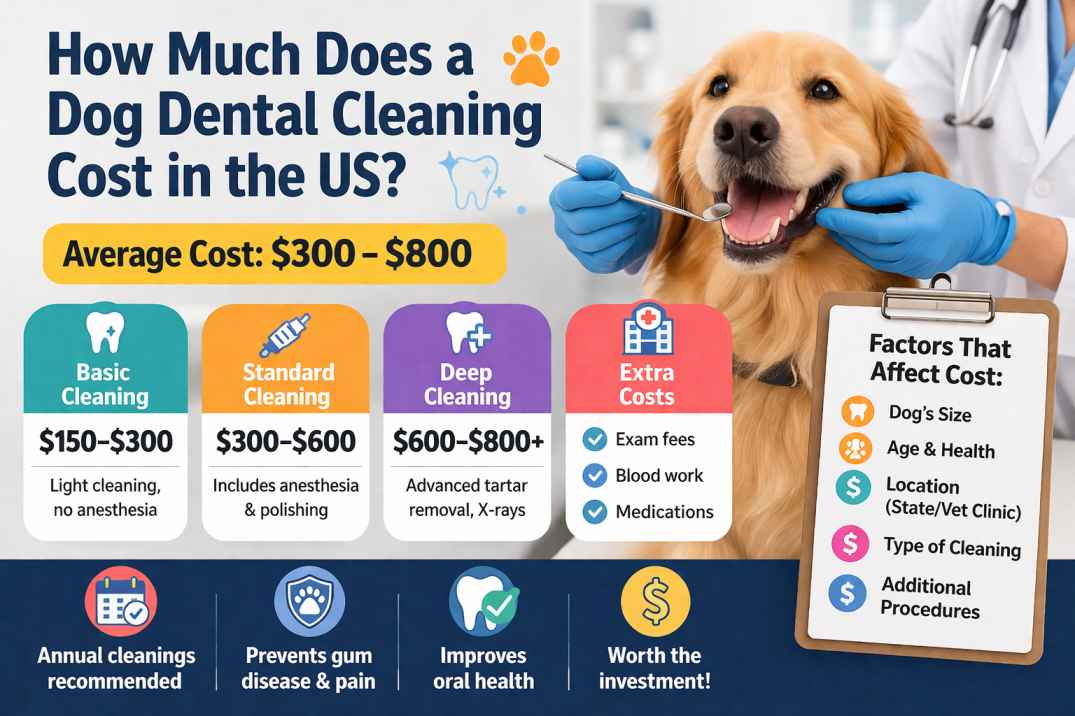
The most important cost fact: Vety's dental cost guide confirms that "because the full extent of dental disease cannot be determined while dogs are awake, veterinarians often don't know ahead of time how many tooth extractions will be needed." This is why final bills sometimes exceed estimates. Always ask your vet to be available by phone during the procedure in case additional findings emerge under anesthesia — and make a pre-authorised decision about how to handle unexpected extractions before your dog goes under.
What Is Actually Included in a Dog Dental Cleaning
Dog dental cleaning is not equivalent to a grooming appointment for the teeth. It is a genuine medical procedure that requires general anesthesia, specialist equipment, and the same level of veterinary attention as most surgeries. Understanding what is involved explains why the cost is what it is.
Pre-anaesthetic examination and bloodwork
Before any dental procedure, your vet will perform a physical examination and run pre-anaesthetic bloodwork to assess organ function — kidneys, liver, and blood cell counts. This confirms the dog can safely undergo general anaesthesia. PetLab Co.'s November 2025 review notes this is done at a separate appointment a few days or weeks before the cleaning, or on the same day at some practices.
$60–$200 depending on panel scopeGeneral anaesthesia and monitoring
This is consistently the largest single cost component. Vety's analysis confirms anesthesia is "one of the primary reasons dog teeth cleanings can be more expensive than pet owners anticipate." The dog is intubated with an endotracheal tube to protect the airway from water and debris, and vital signs — heart rate, oxygen saturation, breathing, blood pressure — are monitored continuously throughout. Larger dogs require more anaesthetic agent; longer procedures require more time under.
$90–$1,200 based on size and procedure lengthFull-mouth oral examination under anaesthesia
PetMD's 2026 veterinary guide describes this as a tooth-by-tooth examination including measuring gum pocket depth with a periodontal probe, checking for fractured teeth, cavities, loose teeth, and performing a full intraoral exam of the soft tissues — tongue, palate, and throat — for masses or ulcers. This examination under anaesthesia is what allows vets to detect issues that a routine awake examination misses entirely.
Included in base procedure costDental radiographs (X-rays)
Full-mouth dental X-rays are recommended at every cleaning. PetMD's veterinary review states that X-rays help detect bone loss, dead teeth, oral cancers, infections, and cysts — issues that are completely invisible on surface examination. A large portion of every dog's tooth lies under the gum line: without X-rays, the most important diagnostic information is simply unavailable. Dogster's 2026 guide puts the standalone cost at $150 to $350 for canine dental X-rays.
$150–$350 · sometimes included in base priceScaling — above and below the gum line
HomeGuide's 2026 analysis describes the process clearly: the vet uses an ultrasonic scaler to break up and remove plaque and tartar, followed by a hand scaler to clean along the gum line and all sides of each tooth. Periodontal probes assess the depth of the pocket between each tooth and the gum above it — abnormally deep pockets indicate periodontal disease requiring additional treatment. Sub-gingival scaling is what separates professional cleaning from everything that can be done at home.
Included in base procedure costPolishing and post-procedure care
After scaling, teeth are polished to remove microscopic scratches from the enamel surface — because rough surfaces accumulate new plaque faster than smooth ones. The mouth is rinsed and suctioned. Many vets apply a fluoride treatment or dental sealant. Some practices apply OraVet delmopinol barrier to slow bacterial reattachment. The dog is then monitored during anaesthesia recovery before being called for pickup.
Included in base procedure costFull Cost Breakdown — Every Line Item Explained
This table consolidates 2026 US cost data from PetMD, Vety, Chewy, Dogster, and Embrace Pet Insurance so you have a single reference before calling your vet.
| Service / Component | Low End | Average | High End | Notes |
|---|---|---|---|---|
| Pre-anaesthetic bloodwork | $60 | $100–$150 | $200 | Required before general anaesthesia; evaluates organ function |
| General anaesthesia | $90 | $300–$600 | $1,200 | Largest cost variable; increases with dog size and procedure length |
| IV catheter and fluids | $50 | $80–$120 | $180 | Required for emergency drug access and hydration during procedure |
| Oral examination | Included | Included | $50–$100 | Tooth-by-tooth probing, pocket measurement; usually bundled |
| Full-mouth dental X-rays | $100 | $150–$250 | $350 | Recommended at every cleaning; detects sub-gingival disease |
| Scaling and polishing | Included | Included | $100–$200 | Core cleaning procedure; usually bundled into base fee |
| Simple tooth extraction (per tooth) | $35 | $75–$150 | $300 | Single-rooted teeth; incisors and smaller premolars |
| Complex tooth extraction (per tooth) | $150 | $200–$350 | $500+ | Multi-rooted teeth (carnassial, large molars); sectioning required |
| Root canal (per tooth) — specialist | $1,500 | $2,000–$2,500 | $3,000 | To save a compromised but structurally sound tooth; specialist only |
| Periodontal treatment (pocket therapy) | $100 | $200–$400 | $600 | Deep root planing and curettage for Stage 2–3 disease |
| Antibiotic injection or prescription | $30 | $50–$100 | $150 | If deep infection found; not always required |
| Pain medication (take-home) | $20 | $30–$60 | $100 | After extractions or periodontal therapy |
Extraction Costs — The Biggest Variable in Any Dog Dental Bill
Tooth extractions are the single most significant driver of unexpectedly high dental bills. Unlike the base procedure, extractions cannot always be predicted before the dog goes under anaesthesia — because sub-gingival disease is not visible until X-rays are taken under anaesthesia.
Vety's 2026 guide is explicit about this: "Multiple tooth extractions are sometimes required and can dramatically increase the price of the procedure." PetMD adds that extraction costs range from $500 to $2,500 per tooth depending on tooth size, complexity, and surgery time — a wide range that reflects the enormous difference between pulling a small lower incisor and surgically sectioning a triple-rooted upper carnassial.
Small single-rooted tooth (incisors, first premolars)
Simple elevation and extraction · Minimal surgical time · Single suture if needed
Medium multi-rooted tooth (second and third premolars)
Must be sectioned into individual roots before extraction · More surgical time
Carnassial tooth (upper fourth premolar — 3 roots)
Largest and most complex extraction · Bone removal often required · Significant suturing
Root canal (to save a tooth) — specialist only
Performed by board-certified veterinary dentist · Preserves the tooth structure · Requires specialist equipment
Multiple extractions in a single session — flat rate
Some practices charge a flat extraction fee for multiple teeth in one session rather than per-tooth pricing · Ask your vet
The pre-authorisation conversation: Before your dog goes under, discuss with your vet: "If you find teeth that need extracting, what is the threshold at which you'll call me, and what should I authorise in advance?" Having a pre-agreed decision removes the stress of an urgent phone call mid-procedure and ensures your dog gets necessary care without unnecessary delay waiting for your callback.
Regional Cost Differences Across the United States
Geography is the most underappreciated cost driver in veterinary dental care. Practice overhead, rent, staffing costs, and local market rates all influence what a vet charges — and these vary enormously between a rural practice in the South and an urban speciality clinic in the Northeast or West Coast.
| US Region | Routine Cleaning Range | With 1–2 Extractions | Notes |
|---|---|---|---|
| Northeast (NY, MA, CT, NJ) | $450–$800 | $800–$1,800 | Highest cost region · NYC especially elevated |
| West Coast (CA, WA, OR) | $400–$750 | $750–$1,600 | San Francisco and Seattle top of range |
| Mountain / Pacific Northwest | $350–$600 | $600–$1,200 | Moderate — varies significantly by urban vs rural |
| Midwest (IL, OH, MI, MN) | $300–$550 | $550–$1,100 | Chicago higher; rural Midwest at the low end |
| South (TX, FL, GA, NC) | $250–$500 | $500–$1,000 | Wide variation · Urban FL/TX higher · Rural GA lower |
| Southeast / Appalachian | $200–$400 | $400–$800 | Typically lowest cost region for routine care |
| Shelter-affiliated clinics (all regions) | $150–$350 | $350–$600 | Subsidised care · Income-based eligibility at some · Limited availability |
February discount tip from Chewy's 2026 DVM panel: Dr. Courtnye Jackson, DVM of Charlotte NC, specifically recommends getting your dog's teeth cleaned in February — National Pet Dental Health Month — when many veterinary practices offer discounts ranging from 10 to 20 percent on dental procedures. This can reduce a $600 routine cleaning to $480 to $540, which is meaningful savings for the same procedure and the same quality of care.
General Practice Vet vs Dental Specialist — Cost Difference
For the majority of dog dental cleanings — routine to moderate disease with straightforward extractions — a general practice veterinarian is fully qualified and equipped to perform the procedure safely and effectively. The significant cost difference between GP vets and board-certified veterinary dentists is warranted only in specific circumstances.
According to PetMD's October 2025 breakdown: "Both general practitioner veterinarians and board-certified veterinary dentists can provide proper dentistry care to your pup." Embrace Pet Insurance's data confirms: general practitioner average bill is $300 to $600; board-certified veterinary dental specialist average is $1,000 to $2,000. PetLab Co.'s November 2025 review agrees, noting the average bill at a specialist is $1,000 to $2,000 depending on services provided.
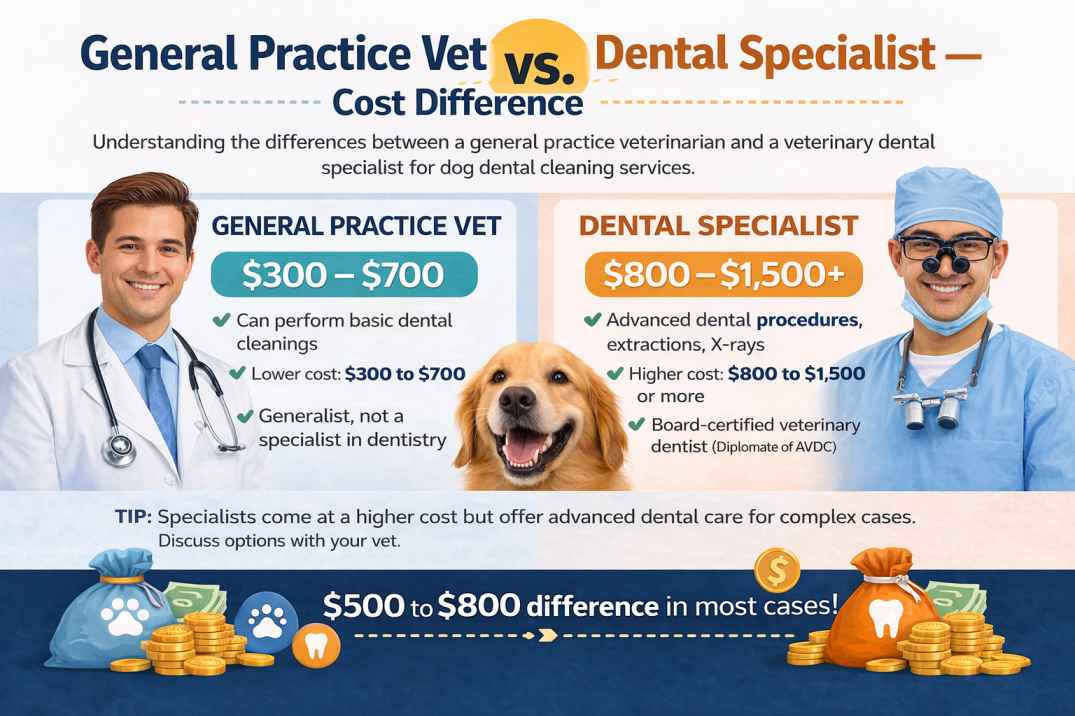
When a specialist is worth the additional cost:
- Root canal procedures to save a tooth — GP vets typically do not perform these
- Jaw fracture repair from advanced bone loss
- Oral masses or tumours requiring surgical management
- Dental crowns (uncommon in veterinary practice but available at specialists)
- Complex periodontal flap surgery in Stage 4 disease
- Cases where a GP vet has identified findings beyond their equipment or training
- Dogs with complicating medical conditions affecting anaesthesia safety
For a standard annual cleaning — even one that includes a couple of extractions — your regular vet is the right choice. Request a written estimate before booking. A vet who is comfortable providing an itemised estimate before the procedure is demonstrating transparency that matters when you pick up the bill at the end.
Pet Insurance and Dental Cleaning Coverage — What's Actually Covered
The short, honest answer on pet insurance and routine dog dental cleaning: most standard plans do not cover it. The nuanced answer: some plans do cover it, and the dental portions of policies vary significantly between insurers.
| Plan Type | Routine Cleaning | Extractions (Disease-caused) | Extractions (Injury/Accident) | Notes |
|---|---|---|---|---|
| Accident-only plans | ❌ Not covered | ❌ Not covered | ⚠️ Sometimes | Only dental injuries from accidents may qualify |
| Accident + Illness plans | ❌ Not covered | ⚠️ Sometimes | ⚠️ Often yes | Dental disease treatment varies widely by insurer |
| Wellness plan add-ons | ✅ Often covered | ❌ Not typically | ❌ Not typically | Check reimbursement cap — often $50–$150 per year |
| Comprehensive dental riders | ✅ Often covered | ✅ Often covered | ✅ Often covered | Additional premium required; read exclusions carefully |
PetLab Co.'s insurance guidance carries an important warning: "Pet insurance plans can refuse to cover pre-existing conditions. In some cases, this can include dental conditions." This means enrolling your dog before any dental disease is diagnosed gives you the best chance of having future dental work covered. Waiting until your dog has documented periodontal disease to enroll virtually guarantees those dental costs will be excluded as pre-existing.
CareCredit is a widely-accepted healthcare financing option that covers veterinary dental procedures at thousands of clinics across the US. Many veterinary practices also offer in-house payment plans. If a dental bill is unmanageable as a single payment, ask your vet practice about payment plans before assuming you cannot afford the procedure.
How to Reduce Dog Dental Cleaning Costs — Practical Strategies That Work
Book in February — National Pet Dental Health Month
Many US veterinary practices offer 10 to 20 percent discounts on dental procedures during February. Chewy's March 2026 expert panel specifically recommends this timing. On a $600 procedure, a 15 percent discount saves $90 — almost the cost of a toothbrush kit and a month of dental chews.
Save 10–20%Check shelter-affiliated and nonprofit veterinary clinics
Chewy's 2026 guide specifically mentions shelter-affiliated clinics as a lower-cost alternative for routine cleanings. Many humane societies, ASPCA affiliates, and nonprofit veterinary organisations offer subsidised dental services, sometimes income-based. Quality of care at these clinics is typically very good — they are staffed by licensed veterinarians with the same training as private practice vets.
Save 20–40%Ask about dental packages and wellness plans
Many practices offer bundled dental packages that include the examination, bloodwork, anaesthesia, X-rays, scaling, and polishing for a flat fee — which is often lower than paying each line item separately. Ask specifically: "Do you offer a dental package, and what does it include?" Some practices also offer in-house wellness memberships that include annual dental cleanings.
Save $50–$200Consider veterinary school dental clinics
Most US states with a veterinary college (Cornell, Colorado State, UC Davis, Purdue, Texas A&M, and others) offer dental procedures through their teaching clinics at significantly reduced rates. Procedures are performed by veterinary students under close supervision by board-certified faculty. Wait times may be longer than private practice, but the quality of care is excellent and the cost reduction is substantial.
Save 30–50%Use CareCredit or Scratchpay to spread the cost
CareCredit is accepted at thousands of US veterinary clinics and offers 0 percent interest promotional periods. Scratchpay is a veterinary-specific financing option with no hard credit inquiry. Both allow you to spread a $600 to $1,500 dental bill over 6 to 24 months. Ask your vet clinic which financing partners they work with before assuming you need to pay the full amount upfront.
0% interest optionsSchedule before disease advances — the most powerful cost strategy
A dog cleaned annually at Stage 1 pays $200 to $500 per visit. A dog cleaned only when symptoms become obvious often presents at Stage 3 or 4 — with a bill of $1,200 to $2,500 and permanent bone loss that cannot be undone. The annual cleaning is not a cost — it is an investment that consistently saves more than it costs over a dog's lifetime. This is the single highest-ROI dental decision any dog owner can make.
Save $1,000+ over lifetimeThe True Cost of Prevention vs Treatment
The numbers here make an argument that no amount of persuasive writing needs to embellish. Look at what the daily prevention routine costs versus what it saves.
💰 Prevention vs Treatment — Annual Cost Comparison
🛒 The Prevention Routine — Products That Keep Cleaning Costs Low
Frequently Asked Questions
Dog teeth cleaning in the US in 2026 ranges from $200 to $800 for a routine cleaning at a general practice veterinarian, including anesthesia, oral examination, scaling, and polishing. PetMD's October 2025 veterinary review puts routine procedures at $350 to $500. Chewy's March 2026 expert review gives an average of $200 to $800. When dental X-rays ($150–$350), tooth extractions ($35–$500 per tooth), or specialist care are needed, total bills can reach $1,500 to $3,500 or more. The single biggest cost driver is the stage of dental disease at the time of the procedure — early intervention costs dramatically less.
Dog dental cleaning costs significantly more than many owners expect primarily because it requires general anesthesia — which costs $90 to $1,200 alone depending on the dog's size and how long the procedure takes. Unlike humans, dogs cannot cooperate with dental instructions, so general anesthesia is necessary to safely clean below the gum line, take full-mouth dental X-rays, probe periodontal pockets, and perform any required procedures with the dog still and pain-free. The cost reflects a genuine medical procedure under anesthesia, not a grooming appointment. Pre-anesthetic bloodwork, IV catheter and fluids, monitoring equipment, and post-procedure care all add to the total.
Dog tooth extraction costs vary significantly by tooth type and complexity. Dogster's 2026 price guide puts simple extractions at $35 to $75 per tooth. Multi-rooted complex teeth — particularly the large upper fourth premolar (carnassial) — can cost $200 to $500 per tooth or more. PetMD states extraction costs range from $500 to $2,500 per tooth depending on tooth size, complexity, and surgery time. Root canals to save a tooth cost $1,500 to $3,000 at a board-certified veterinary dental specialist. Multiple extractions in a single session are sometimes charged at a flat rate — ask your vet before the procedure how they price multiple extractions.
Standard pet insurance accident and illness policies typically do not cover routine dental cleanings because they are classified as preventive care. Wellness plan add-ons often include partial dental cleaning coverage — usually $50 to $150 toward the procedure. Some comprehensive dental riders cover cleanings, disease-related extractions, and injury-related dental work. PetLab Co.'s November 2025 review warns that pre-existing dental conditions are commonly excluded, so enrolling before any dental disease is documented gives the best coverage outcome. Always read the dental section of any policy before relying on it for cleaning costs.
Six strategies consistently reduce dog dental cleaning costs without compromising quality: Book in February during National Pet Dental Health Month when many practices offer 10 to 20 percent discounts. Check shelter-affiliated and nonprofit veterinary clinics for subsidised cleaning rates. Ask about dental packages that bundle services at a flat rate below itemised cost. Consider veterinary school teaching clinics which offer procedures at 30 to 50 percent below private practice rates under faculty supervision. Use CareCredit or Scratchpay to finance the cost over 6 to 24 months at 0 percent interest in promotional periods. Most importantly, schedule annual cleanings before disease advances — a $400 Stage 1 cleaning today prevents a $2,000 Stage 3 bill in three years.
Most veterinarians recommend annual professional dental cleaning for adult dogs. The American Animal Hospital Association (AAHA) recommends small dogs have their first cleaning by age one and large dogs by age two. Some dogs — particularly small breeds, brachycephalic breeds, and those with existing dental disease — benefit from biannual cleanings every six months. Dogs receiving excellent daily home care (daily brushing, VOHC chews, water additive) and with no existing dental disease may be able to extend the interval between professional cleanings based on their vet's assessment at each wellness exam. Chewy's March 2026 expert review confirms that how much a dog chews, their size, and the quality of home dental care all affect cleaning frequency recommendations.
The Bottom Line on Dog Dental Cleaning Cost — April 2026
The range is real: $200 for a simple routine cleaning, $3,500 for advanced Stage 4 disease with multiple extractions and specialist involvement. Both numbers are accurate. The distance between them is almost entirely created by one factor: how long the dental disease was allowed to progress before the first cleaning was scheduled.
The math is unambiguous. Annual cleaning at $350 to $500, plus a $576-per-year prevention routine, costs roughly $950 per year. Stage 3 to 4 disease treatment, when it eventually arrives in an uncared-for mouth, costs $1,500 to $3,500 in a single bill — and leaves the dog with permanent bone loss, possibly fewer teeth, and chronic pain that existed for months or years before it was addressed.
Schedule the annual cleaning. Start the daily home routine. Book in February to save 15 percent. The expense is real but it is vastly smaller than the alternative — and your dog's experience of not being in chronic oral pain is something no price tag can be placed on.