Dental Chews vs Brushing: What Actually Works Better for Dogs?
Every dog owner has wondered this. Is the daily brushing battle worth it? Or can a quality dental chew do the same job more peacefully? The answer — backed by peer-reviewed 2026 clinical research — is more nuanced than most articles will tell you. Brushing wins on effectiveness. But the wrong brushing routine beats nothing by less than you think. And the right dental chews do real, measurable work. Here is the full honest breakdown.
Quick Answer — What the 2026 Research Shows
🪥 Toothbrushing
🦴 Dental Chews
What the Clinical Research Actually Shows — Not What Brands Claim
Before comparing these two approaches, let us be clear about what counts as evidence in 2026. Marketing copy on a chew package does not count. A vet's personal preference does not count. What counts is peer-reviewed clinical data — studies conducted on actual dogs with measurable, independently verified outcomes.
The research position is unambiguous on one point: toothbrushing is the gold standard of at-home canine oral care. This finding has been replicated across multiple studies, confirmed by the PMC peer-reviewed dental chew efficacy study, and endorsed by every major veterinary authority — Vetster, VCA Animal Hospitals, BARK Post's DVM team, and SpectrumCare's 2026 VOHC analysis. No product currently on the market matches brushing's effectiveness at fighting periodontal disease.
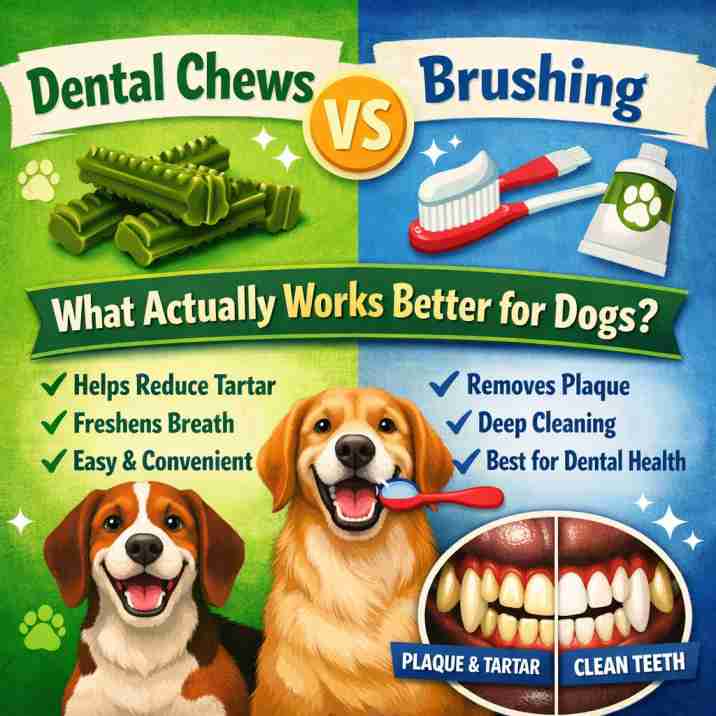
But here is what most articles miss: the clinical advantage of brushing over chews depends entirely on consistency and technique. Daily brushing done correctly reduces tartar and plaque by a significant 25 to 30 percent. But research cited in the PMC dental chew study found that in a survey of over 200,000 Swedish dog owners, nearly 40 percent thought brushing was of minor importance or not important at all — and realistically, even more owners brush infrequently or inconsistently. Brushing done once a week provides minimal clinical benefit.
That third statistic is the one that changes everything. In theory, brushing beats chews. In practice — for the large proportion of dog owners who find consistent brushing difficult — a VOHC-approved daily dental chew is not merely "second best." It is the best achievable result, and it does genuinely measurable work.
PMC peer-reviewed study finding (2020, PMC7511057): Dogs given daily dental chews showed significantly reduced oral malodour — measured as volatile sulfur compounds — compared to control dogs from day 14 onward, with continued improvement through day 27. The researchers concluded that daily dental chew consumption "may provide a convenient adjunctive method" to brushing. Not a replacement — an adjunct. But a meaningful, clinically verified one.
How Brushing Works — And Where Most People Go Wrong
Toothbrushing removes plaque through direct mechanical action. Bristles physically scrub the tooth surface and — critically — penetrate the gum line where plaque accumulates fastest and periodontal disease begins. This sub-gingival access is what makes brushing irreplaceable: it disrupts the bacterial biofilm in the exact location that no chew, water additive, or spray can reliably reach.
Enzymatic toothpaste adds a biological layer. Enzymes like glucose oxidase and lactoperoxidase are activated by contact with oral bacteria and continue producing antimicrobial compounds for 30 to 60 minutes after the brush leaves the mouth. The mechanical cleaning of brushing combined with the enzymatic activity of the toothpaste is why the Virbac C.E.T. combination — VOHC seal awarded 2026 for plaque and tartar claims — is the gold-standard home dental recommendation in most US veterinary practices.
The Six Brushing Mistakes That Eliminate Its Advantage
- Brushing the wrong teeth. Most owners brush front teeth because they are easiest to reach. The Merck Veterinary Manual confirms that back teeth are affected more severely by dental disease — the upper molars and premolars on the cheek-facing surface accumulate the most plaque. Start there.
- Not reaching the gum line. Brushing the crown of the tooth cleans what is already relatively clean. Hold the brush at 45 degrees toward the gum line on every tooth — that angle drives bristles into the gingival sulcus where bacteria live.
- Using human toothpaste. Dangerous, not just ineffective. Human toothpastes contain xylitol or fluoride — both toxic to dogs. Always use dog-specific enzymatic toothpaste.
- Brushing less than 2–3 times per week. Plaque hardens into tartar within 24 to 72 hours. Weekly brushing cannot interrupt that cycle meaningfully. Every-other-day is the minimum for real protection.
- Rushing the introduction and giving up. Dogs who resist brushing do so because it was introduced too aggressively. Use a five-day desensitisation approach: finger on gums, finger brush, small-head toothbrush. High-value flavoured enzymatic paste as a treat association makes the difference.
- Assuming a bad routine is better than chews. A once-weekly stressful brushing session your dog fights provides minimal dental benefit. It may actually make your dog more resistant to dental handling over time. If you cannot brush at least every other day, a consistent chew-plus-water-additive routine provides better real-world outcomes.
The real-world compliance problem: Clinical studies report brushing's effectiveness under controlled daily conditions. Most household dogs are brushed less often, less correctly, and with more resistance. The actual gap between brushing and quality chews in real-world daily life is considerably smaller than the 25–30% versus 10–20% comparison suggests — because real-world brushing rarely achieves the consistency that produces 25–30% reduction.
How Dental Chews Work — And Which Ones Actually Do Anything
Dental chews work through two mechanisms: mechanical abrasion and chemical action. The chewing motion creates friction against tooth surfaces, physically scraping away soft plaque. Chews designed with ridges, porous texture, or unique shapes create more tooth surface contact per chew — which means more plaque removal per session. This is why chew shape and texture are not cosmetic design choices — they are the delivery mechanism for the product's dental benefit.
Quality chews also include active ingredients. Some carry enzymes similar to enzymatic toothpastes. OraVet carries delmopinol — a specific antimicrobial that disrupts the biofilm matrix that plaque bacteria use to adhere to tooth surfaces. This chemical mechanism provides ongoing benefit between brushings, which is part of why daily chewing on the right product produces measurable results even in the absence of brushing.
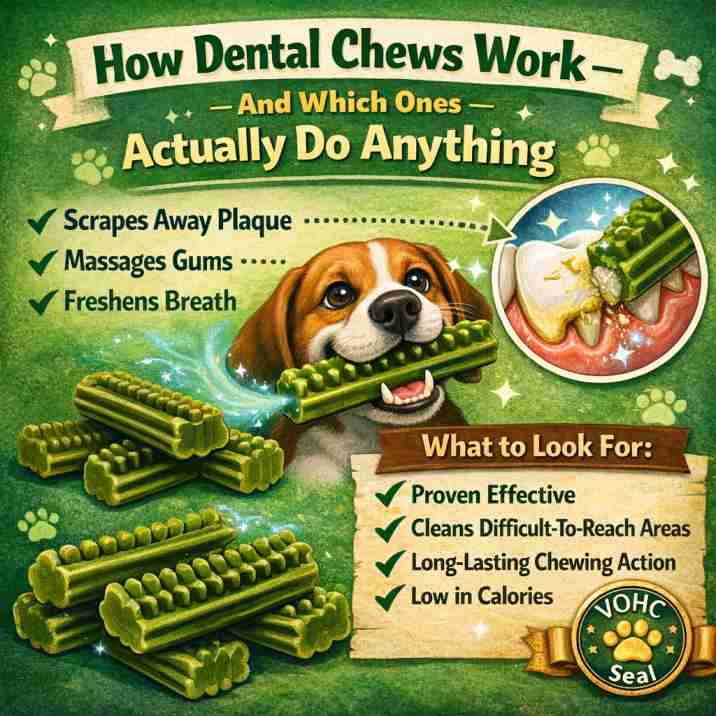
However, two limitations are absolute and cannot be overcome by any chew, regardless of quality. First: no chew reaches below the gum line. The chewing action affects visible tooth surfaces — not the sub-gingival zone where periodontal disease begins and where professional scaling is the only tool. Second: no chew removes hardened tartar. Once plaque has mineralised into calculus, only ultrasonic scaling under anaesthesia removes it. Chews slow the accumulation of new tartar. They do not dissolve existing deposits.
The VOHC Distinction — Non-Negotiable
The Veterinary Oral Health Council awards its Seal of Acceptance only to products that have submitted independent clinical trial data proving plaque or tartar reduction above a statistically significant threshold. This seal is voluntary — brands pay to submit products for review — which means many effective products have not applied. But for products that carry the seal, you have verified independent evidence. For products without it, dental claims on packaging are marketing language with no independent verification requirement.
Pine Ridge Pet Clinic's 2025 guidance and SpectrumCare's 2026 VOHC analysis both confirm: "Brushing is still the most effective home method for preventing dental disease, and dental chews are usually an add-on rather than a replacement."
The hardness rule — always apply this before buying any chew: If you cannot dent the chew surface with your thumbnail, it is too hard for your dog's teeth. Real bones, antlers, hooves, hard nylon, and ice cubes all fail this test and all cause slab fractures — particularly of the upper carnassial tooth — which are among the most painful and expensive dental conditions to treat. The risk significantly outweighs any cleaning benefit. This rule applies universally.
Head-to-Head Comparison — 8 Criteria
VOHC-Approved Dog Dental Chews in 2026 — The Only Ones Worth Buying
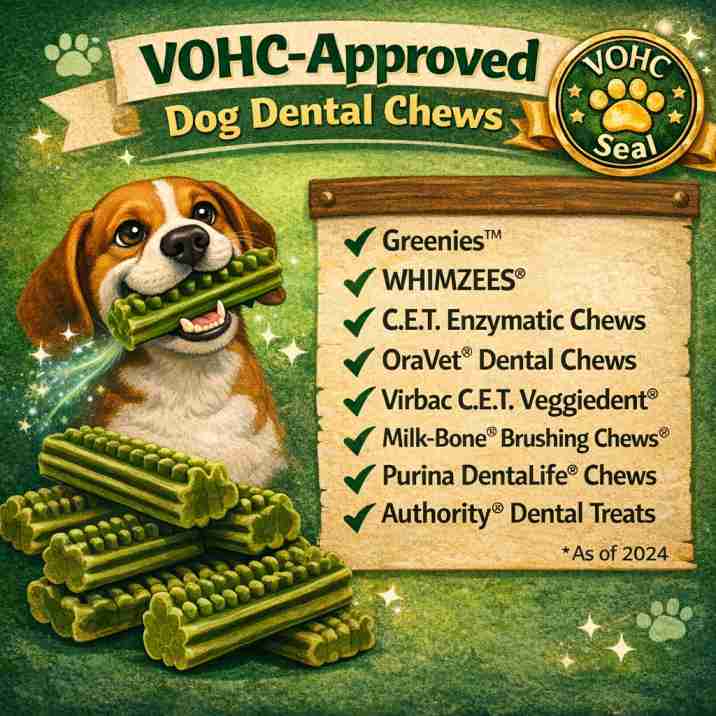
Based on the official VOHC dog product list updated February 2026, confirmed by SpectrumCare's analysis, these are the consumer-available dental chews that have passed independent clinical trials. Products with both plaque and tartar claims have stronger overall evidence than those with only one claim.
Important from Vetster's 2026 guidance: If your dog already has visible tartar, persistent bad breath, or any sign of dental disease, consult your vet before starting dental chews. Dogs with existing disease may need a professional cleaning before chews are appropriate — starting home care on a severely compromised mouth without first addressing the existing disease can, in some situations, push bacteria deeper into inflamed tissue. Get the baseline cleaning, then maintain with the routine below.
When Are Chews Enough on Their Own?
This is the question most dog owners actually want answered. The honest, conditional answer from 2026 clinical guidance is this: VOHC-approved dental chews used daily are a viable primary oral care tool in a specific, narrow set of circumstances.
Chews-only is reasonable if: your dog has a professionally clean mouth (recent professional scaling), is not a high-risk breed (small or brachycephalic dogs), is under age five with no existing dental disease, and you schedule annual professional veterinary dental examinations to monitor for any accumulation. Under these conditions, daily VOHC chews plus a water additive provide meaningful protection.
In every other situation — existing tartar, gum redness, a small or flat-faced breed, a dog over age five, or any observable dental disease sign — chews alone are insufficient. Vetster's clinical guidance states this directly: chews "are best used in addition to brushing and in between professional dental cleanings to help limit the buildup of plaque. Not instead of. In addition to."
The sugar-free gum analogy — used by Wolfe Animal Hospital: Think of dental chews as the dog equivalent of sugar-free chewing gum. Gum does provide some mechanical cleaning and breath freshening benefit. Nobody uses it instead of brushing their own teeth. Nobody would tell you gum plus a dental check-up once a year constitutes complete oral care. The dental chew is a useful, evidence-backed tool. It is not a complete system on its own.
Which Routine Fits Your Situation?
Your dog tolerates brushing and currently has healthy teeth
Daily brushing with VOHC enzymatic toothpaste, one VOHC dental chew daily, and a tasteless water additive in every bowl refill. This is the optimal routine — maximum plaque prevention, best breath outcomes, and the longest realistic interval between professional cleanings. Annual veterinary dental examination to catch what home care misses.
Your dog refuses brushing entirely
One VOHC-approved dental chew daily in the correct size for your dog's weight, plus Oxyfresh or similar tasteless water additive every bowl refill. This delivers meaningful ongoing plaque reduction and breath improvement without any brushing. Increase professional veterinary cleanings from annual to biannual to compensate. Reattempt brushing desensitisation every three to four months using the five-day finger-first approach.
You brush once or twice a week and give chews occasionally
This is the most common situation — and the one with the biggest gap between intention and outcome. Once-weekly brushing provides minimal clinical benefit. Occasional chews provide occasional benefit. Neither is consistent enough to matter much. The single most impactful change: make the chew a daily non-negotiable (easiest) and work toward every-other-day brushing. Consistency beats intensity in dental care every time.
You have a Chihuahua, Yorkshire Terrier, French Bulldog, or similar small breed
Small and brachycephalic breeds have the highest periodontal disease rates of any dog group because crowded teeth in smaller jaws create more plaque traps. VOHC chews specifically sized for small dogs daily. Brushing starting at age six months. Professional cleanings annually from age one, not two. This group has significantly less margin for dental care shortcuts than larger breeds — the disease progresses faster and the consequences are more severe proportionally.
Your dog is over age seven with no recent professional dental cleaning
Do not start either chews or brushing without a professional veterinary dental examination first. Senior dogs without recent cleaning almost certainly have established tartar and potentially early-to-moderate periodontal disease. Starting home care on a compromised mouth without addressing the existing disease first is ineffective — and in some cases counterproductive. Get the veterinary baseline cleaning, establish the disease stage, then start the appropriate home routine with your vet's specific guidance.
The Best Dog Dental Routine — Combining Both for Maximum Protection
The question of chews versus brushing is ultimately a false choice. Every veterinary authority in 2026 gives the same answer: use both, every day, plus annual professional cleaning. Here is what that looks like in practice — specific, actionable, achievable.
Daily brushing — 60 seconds, every day or every other day minimum
Use VOHC-approved enzymatic toothpaste — Virbac C.E.T. (VOHC seal 2026, plaque and tartar) is our top pick for brushing because the dual-enzyme system continues fighting bacteria after the brush leaves the mouth. Focus on outer surfaces of upper back teeth at a 45-degree angle toward the gum line. No rinsing — the enzymes need to stay in contact. Even 30 seconds daily beats two minutes weekly by a significant clinical margin.
One VOHC-approved dental chew daily — after morning feeding
Give it at the same time every day so both you and your dog build the habit. After morning feeding works well because recent food debris gives the chew something to work against. Use the correct size for your dog's body weight — the package size chart is not a suggestion, it is a safety guide. An undersized chew does not engage the back teeth. An oversized chew puts inappropriate pressure on jaw joints. One chew per day, correct size, consistently — that is the protocol.
Water additive in every bowl refill — zero effort required
Add Oxyfresh or a comparable tasteless, odourless VOHC-class water additive every time you completely refill the bowl. One capful per 32oz of fresh water. The active Oxygene technology contacts oral bacteria every time your dog drinks — passive protection that works around the clock between brushings and chews. This is the zero-effort, zero-resistance tier of the routine that any owner can maintain regardless of how much their dog cooperates with other dental interventions.
Annual professional veterinary cleaning — non-negotiable
No home routine removes sub-gingival tartar that has already hardened. The AAHA recommends annual professional cleaning starting at age one for small breeds and age two for large breeds, under general anaesthesia with dental radiographs. For dogs receiving no daily home care, biannual cleanings are often indicated. The home routine is what extends the interval between professional cleanings — it does not eliminate the need for them. Think of it this way: you brush your teeth daily, and you still see the dentist twice a year. Your dog deserves the same logic.
🛒 Our 2026 Top Picks — One for Each Tool
Frequently Asked Questions
No — but the gap is smaller than most articles admit, and it depends on consistency. Multiple peer-reviewed studies confirm that toothbrushing is the gold standard of at-home canine oral care. VOHC-approved dental chews reduce plaque by approximately 10 to 20 percent with daily use — roughly half to two-thirds of what consistent daily brushing achieves. For brush-resistant dogs, daily VOHC chews are significantly better than inconsistent or no brushing. The PMC peer-reviewed dental chew study found measurable breath improvement from day 14 of daily chew use compared to control groups.
You can use VOHC-approved chews as the primary oral care tool for dogs who genuinely cannot tolerate brushing — this is meaningfully better than no oral care at all. However, chews cannot clean below the gum line, cannot remove hardened tartar, and do not match brushing effectiveness. If using chews without brushing, increase professional veterinary cleanings from annual to biannual. Vetster, VCA Animal Hospitals, and SpectrumCare all confirm that chews work best alongside brushing, not as a complete replacement.
Daily brushing done with correct technique reduces tartar and plaque by 25 to 30 percent. VOHC-approved dental chews used daily reduce plaque by approximately 10 to 20 percent — roughly half to two-thirds of what consistent brushing achieves. A PMC peer-reviewed study found dental chews significantly reduced oral malodor compared to control dogs after 14 to 27 days of daily use. These numbers represent ideal clinical conditions — real-world results for brushing are often lower due to inconsistency, while chew results are more consistent because dogs administer them cooperatively.
Only dental chews with the VOHC Seal of Acceptance have passed independent clinical trials. As of February 2026, the VOHC approved dog chew list includes Greenies Original, OraVet Dental Hygiene Chews, WHIMZEES BRUSHZEES, Purina DentaLife, Virbac C.E.T. VEGGIEDENT chews, ProDen PlaqueOff Dental Care Bones, and several others including Checkups Chews, Member's Mark Dental Treats, and Yummy Combs. Non-VOHC chews have not been independently tested — their dental claims are marketing without verified clinical evidence behind them.
No. Veterinary dental specialists in 2026 warn uniformly against antlers, real bones, hooves, hard nylon, and ice cubes. The thumbnail test is the universal standard: if you cannot dent the chew surface with your thumbnail, it is too hard for your dog's teeth. Hard chews cause slab fractures — particularly of the upper fourth premolar — which are among the most painful and expensive dental conditions to treat, often requiring extraction or root canal. The risk significantly outweighs any cleaning benefit. This applies to all dog sizes and breeds.
The optimal routine in 2026 combines: daily brushing with VOHC-approved enzymatic toothpaste for 30 to 60 seconds focusing on outer surfaces of upper back teeth, one VOHC-approved dental chew daily in the correct weight-appropriate size, a tasteless water additive added to every fresh bowl refill, and annual professional veterinary cleaning starting at age one for small breeds and age two for large breeds. For dogs who absolutely cannot tolerate brushing, replace it with a water additive and increase professional cleanings to biannual frequency.
The Bottom Line — April 2026
Brushing wins on effectiveness when done daily and correctly. But a dental chew used every single day often outperforms brushing done once a week in real-world outcomes — because consistency is what actually produces results, and chews are the tool dogs cooperate with most reliably.
The answer is not choosing between them. The answer is building the three-tool routine — daily brushing when possible, one VOHC-approved chew every day, water additive in every bowl — and scheduling annual professional cleanings to address what home care cannot reach. Start tonight with the chew. The rest can follow as your dog builds tolerance.