Dog Dental Disease: 7 Warning Signs Every Owner Must Know in 2026
In 2025, data from over 3 million US clinic visits confirmed that 73% of dogs had dental-related issues. Most owners found out too late — after a $519 vet bill, or worse. This guide tells you exactly what to look for, what each sign means, and what to do before it becomes an emergency.
Why Dog Dental Disease Is a Silent Crisis in 2026
Most US dog owners know their dog needs dental care. Almost none of them actually do it. That gap is the entire problem.
The numbers in 2026 are sobering. The global pet dental health market is valued at $4.5 billion — driven by the fact that dental disease is now the most commonly diagnosed condition in companion animals. A 2025 Banfield Pet Hospital analysis covering more than 3 million pets across 1,000+ US clinics found that 73% of dogs had dental-related health issues. The American Veterinary Dental College puts the lifetime risk even higher: more than 80% of dogs show signs of periodontal disease by age three.
The reason this matters beyond the dog's comfort: untreated periodontal disease does not stay in the mouth. The AVMA has confirmed that the bacteria responsible for gum disease can enter the bloodstream and cause measurable damage to the kidney, liver, and heart muscle. Small dog breeds — Chihuahuas, Yorkshire Terriers, Dachshunds, Beagles — face the highest risk because their teeth are crowded into smaller jaws.
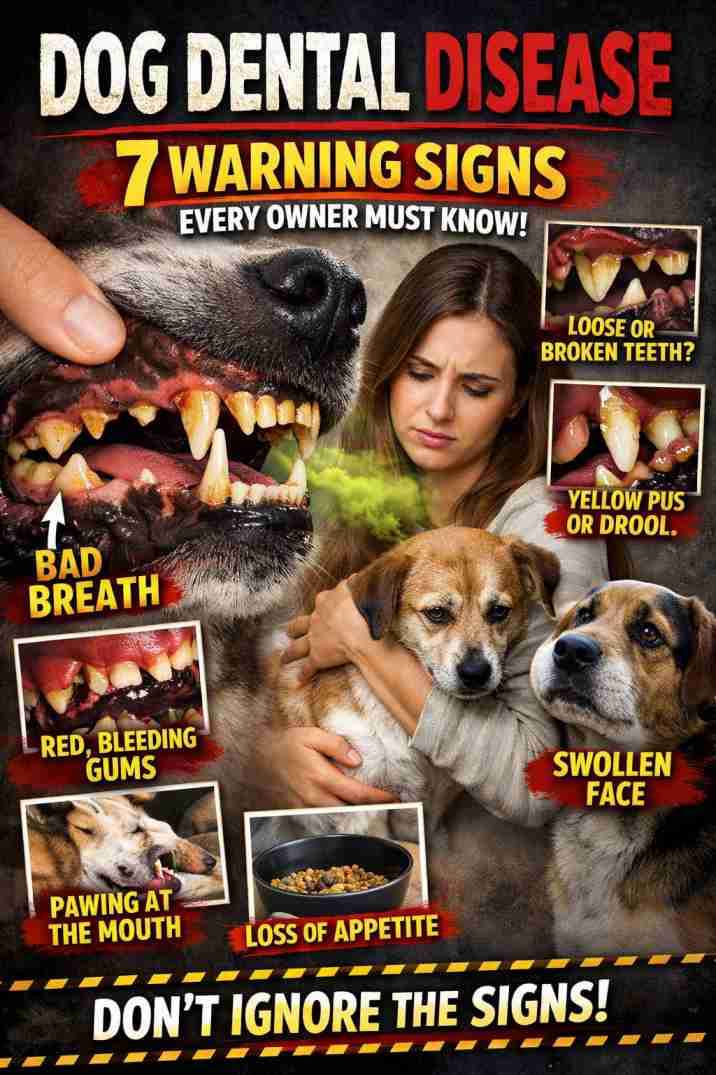
Here is what makes this preventable: the early signs are visible to any owner who knows what to look for. The seven warning signs below represent every stage of dental disease, from earliest (easily reversed) to most advanced (requiring urgent veterinary intervention).
Important: If your dog is showing signs #5, #6, or #7 below, do not delay. Contact your veterinarian today. Advanced periodontal disease causes chronic pain — dogs are expert at hiding it.
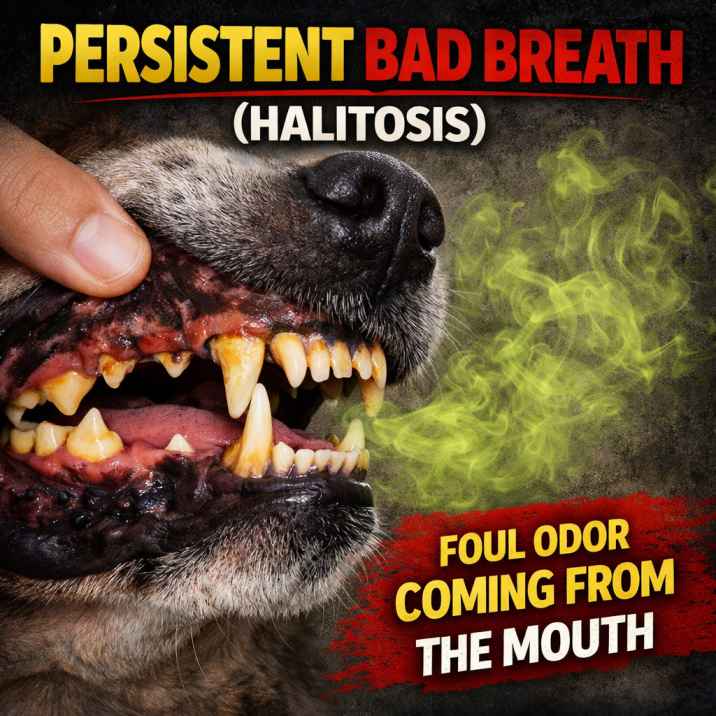
Sign #1 — Persistent Bad Breath (Halitosis)
Persistent Bad Breath
Every dog has some degree of "dog breath." That is normal. What is not normal is breath that is consistently foul, sour, or fishy — the kind that hits you from across the room when your dog yawns or pants.
Persistent halitosis is caused by volatile sulfur compounds (VSCs) produced by anaerobic bacteria feeding on food debris and dying tissue in your dog's mouth. It is almost always the first external sign that bacterial colonies are establishing themselves on tooth surfaces.
The error most owners make: assuming bad breath is just "a dog thing." It is not. A healthy dog with a clean mouth should have breath that is neutral to mildly meaty — unpleasant if you sniff closely, but not overwhelming. If you can smell your dog's breath from a normal conversational distance, something is wrong.
Sign #2 — Yellow or Brown Tartar Buildup on Teeth
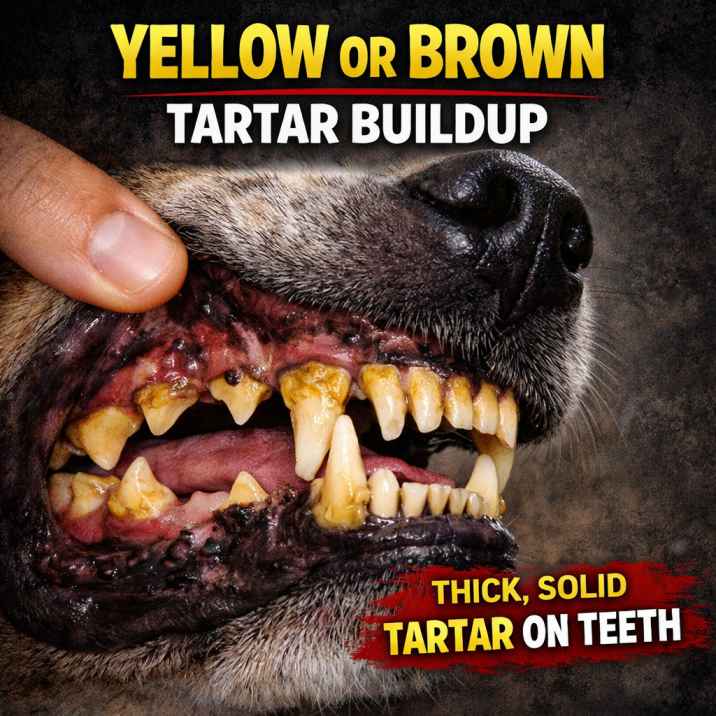
Visible Tartar Buildup
Plaque is the soft, sticky film of bacteria that coats teeth within hours of eating. When plaque is not removed, it mineralizes into tartar (calculus) within 24–72 hours — and once tartar forms, no amount of brushing, chewing, or water additives will remove it. Only professional veterinary scaling can.
You will see tartar as a yellow to dark brown chalky coating on the tooth surface — most visible on the upper canine teeth and the back molars. It often forms first along the gum line. In dogs over age 3 without regular dental care, it is almost universal.
Tartar above the gum line is cosmetically concerning. Tartar below the gum line — which you cannot see — is where the real damage happens: it creates pockets between tooth and gum where bacteria thrive, destroying the ligaments and bone that hold teeth in place.
Sign #3 — Red, Swollen, or Bleeding Gums (Gingivitis)
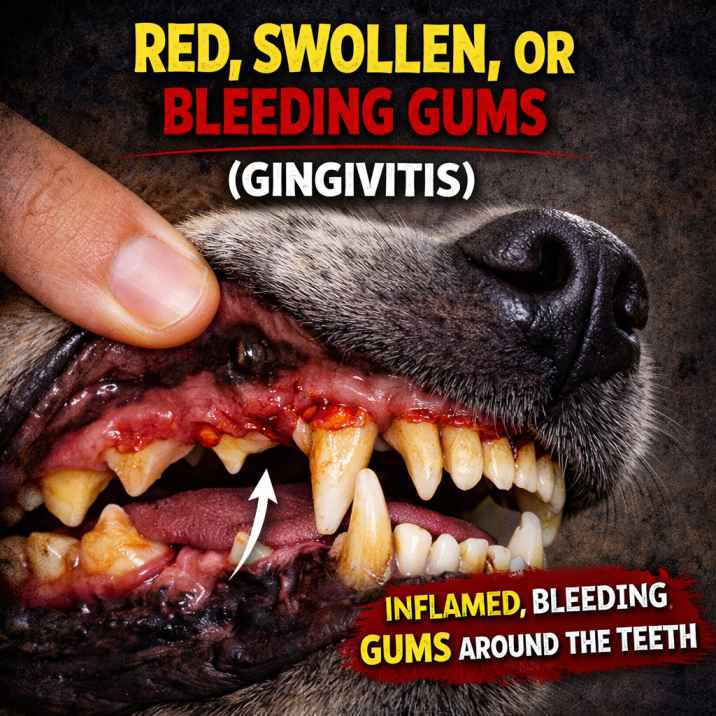
Inflamed or Bleeding Gums
Healthy dog gums are firm, pale pink, and do not bleed when touched. Any deviation from this — redness, puffiness, dark red lines along the gum edge, or bleeding when you touch the gums or when your dog chews — is gingivitis: active inflammation caused by bacterial toxins in tartar.
Gingivitis is the last fully reversible stage of periodontal disease. Remove the tartar through professional cleaning, eliminate the bacteria through home care, and the gums can fully recover. Beyond gingivitis, tissue and bone damage is permanent.
To check your dog's gums: gently lift the lip and look at the gum line along the upper front teeth. The gum should meet the tooth cleanly with no redness or swelling. Press the gum gently — it should immediately return to pink (this is called the capillary refill test).
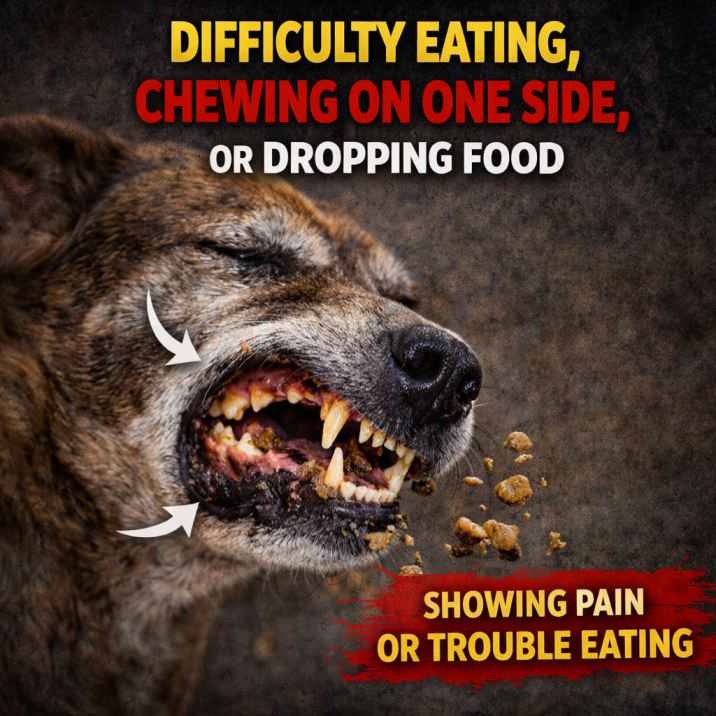
Sign #4 — Difficulty Eating, Chewing on One Side, or Dropping Food
Eating Difficulties or Changed Chewing Pattern
This is the sign most owners miss — and it is the one that indicates your dog is in active, consistent pain. Dogs are biologically hardwired to not show weakness. A dog who is visibly struggling to eat has reached the point where the pain is overwhelming that biological instinct to hide it.
Watch for: chewing only on one side of the mouth (avoiding a painful area), dropping kibble mid-meal, eating much more slowly than usual, reluctance to chew hard treats or toys they previously loved, or a preference for soft food they never previously showed.
This pattern is most commonly caused by one or more of the following: a cracked or fractured tooth, an exposed tooth root, severe periodontal bone loss, or a periapical abscess (infection at the tooth root). All of these require professional veterinary treatment — none can be managed at home.
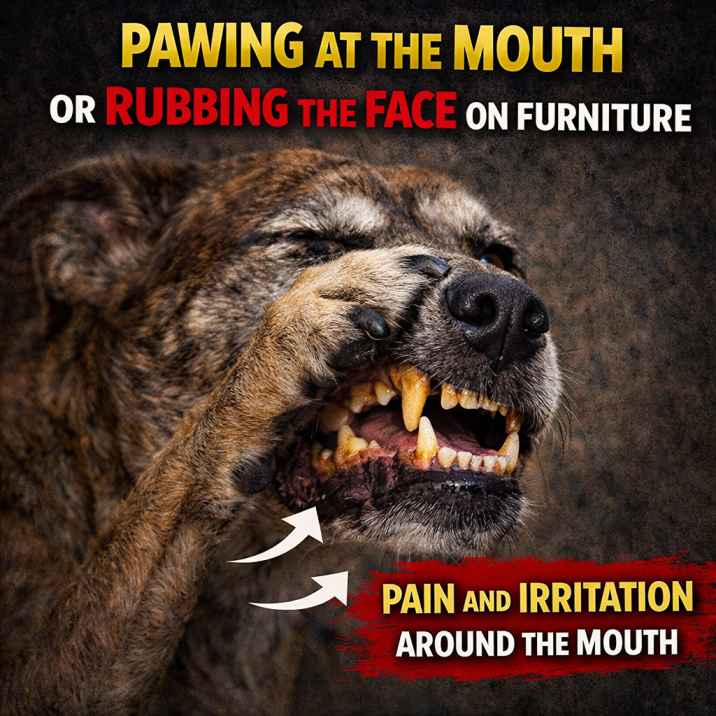
Sign #5 — Pawing at the Mouth or Rubbing the Face on Furniture
Pawing, Rubbing, or Scratching the Mouth Area
When a dog paws at their mouth or drags their face along carpet or furniture, they are trying to relieve acute oral discomfort. This behavior indicates pain or irritation that has become severe enough to override normal behavior — it is not a quirk, and it is not normal.
Common causes at this stage: a tooth abscess, an exposed or broken tooth root, severe gum inflammation, or a foreign object lodged between teeth or in the gum tissue. In some cases, it can also indicate an oral mass or growth — which requires immediate diagnosis.
Do not confuse this with normal face-rubbing after eating (which can be just a cleanup instinct). The concerning pattern is repeated, persistent pawing or rubbing that seems compulsive or is accompanied by other signs on this list.
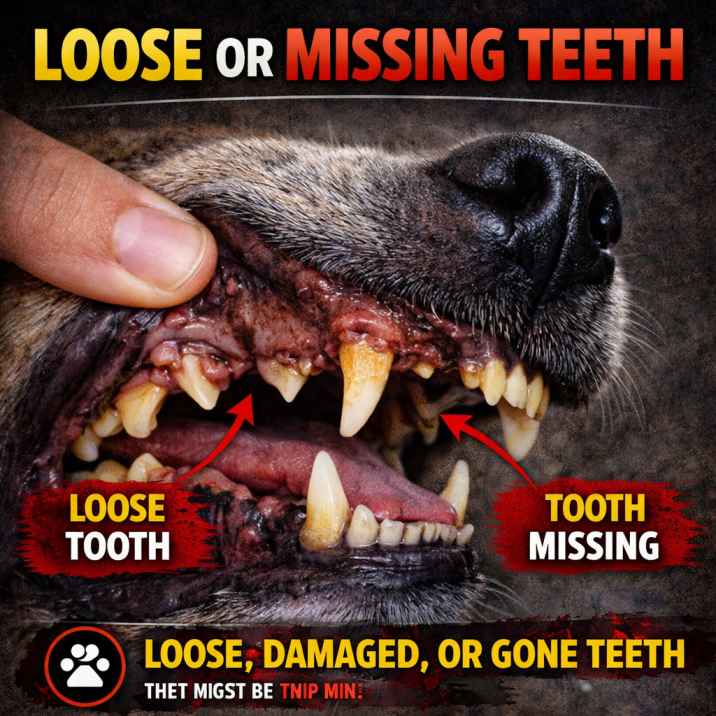
Sign #6 — Loose or Missing Teeth
Loose, Wobbly, or Missing Adult Teeth
Healthy adult dog teeth do not fall out. Loose or missing teeth in an adult dog are a direct indicator of significant bone and ligament loss around the tooth root — the end result of untreated periodontal disease progressing to Stage 3 or Stage 4.
By this stage, the supporting structures have been so degraded by bacterial infection that the tooth can no longer be held in the jaw. The tooth may need to be extracted to prevent the infection from spreading further into the jaw bone (a condition called osteomyelitis, which is significantly more serious and expensive to treat).
According to Zoetis Petcare, 6% of dogs in one large study had experienced tooth loss related to periodontal disease — meaning millions of US dogs have reached this preventable endpoint.
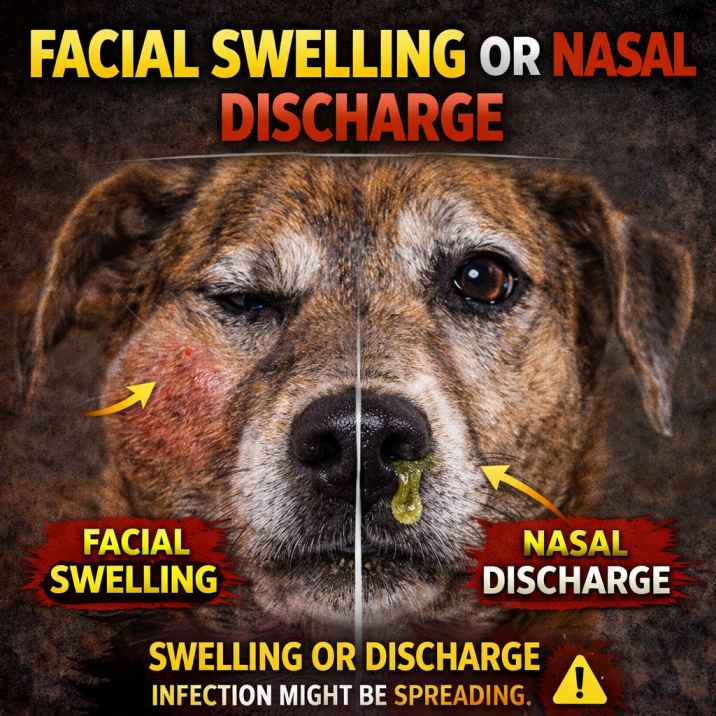
Sign #7 — Facial Swelling or Nasal Discharge
Swelling Below the Eye or Nasal Discharge
A visible swelling below the eye in a dog almost always indicates a tooth root abscess — most commonly affecting the carnassial tooth (the upper fourth premolar), whose roots sit directly below the eye socket. This is a dental emergency.
The same applies to unexplained nasal discharge — particularly if it affects only one nostril and is persistent. The upper molar roots in dogs sit very close to the nasal cavity, and a root abscess or severe periodontal pocket can create a fistula (abnormal opening) between the mouth and the nasal passage.
By this stage, the infection has very likely spread beyond the tooth into surrounding tissue. Without treatment, dental abscesses can spread into the jaw bone, sinuses, or — in the most severe cases — become systemic (septic) infections that are life-threatening.
The 4 Stages of Dog Dental Disease — What Each Means
Veterinarians classify dog periodontal disease in four stages. Knowing which stage your dog is in determines what treatment is necessary — and what it will cost.
| Stage | What Vets See | Your Dog Feels | Treatment | US Cost (2026) |
|---|---|---|---|---|
| Stage 1 — Gingivitis | Plaque + mild gum redness. No bone loss yet. | Mild discomfort. No pain at rest. | Professional cleaning. Home care. | $100–$300 |
| Stage 2 — Early Periodontitis | Gum pockets <25% bone loss around 1+ teeth. | Dull aching. Reluctant to chew hard foods. | Deep scaling (under anesthesia). Daily home care required. | $300–$600 |
| Stage 3 — Moderate Periodontitis | 25%–50% bone loss. Visible gum recession. | Active pain. Behavioral changes. Eating difficulty. | Scaling + possible extractions. Radiographs required. | $500–$1,200 |
| Stage 4 — Advanced Periodontitis | >50% bone loss. Loose teeth. Possible abscess. | Severe pain. Obvious distress. Swelling possible. | Multiple extractions. Possible jaw surgery. Antibiotics. | $800–$3,000+ |
Key fact: Stage 1 is the only stage that is fully reversible. Stages 2–4 cause permanent bone loss that cannot be restored. This is why catching early signs matters — the difference between a $150 cleaning and a $2,000 surgery is literally a matter of months.
Prevention vs. Treatment: The Real Cost Difference in 2026
The most compelling argument for daily dog dental care is not health — it is money. Here is what prevention costs compared to what treatment costs, based on current US veterinary pricing in 2026.
✓ Prevention (monthly)
✗ Treatment (when ignored)
The math is straightforward. Consistent prevention costs roughly $52 per month. A single Stage 2–3 periodontal treatment costs more than 19 months of prevention. And that is without the follow-up appointments, antibiotics, and additional extractions that often accompany advanced disease.
Which Dog Breeds Face the Highest Dental Disease Risk in 2026
Breed-specific risk is significant. A 2024 Waltham Petcare Science Institute study analyzed nearly 3 million Banfield Pet Hospital records across 60 dog breeds and found that small breeds consistently show the highest rates of periodontal disease — driven primarily by tooth crowding in smaller jaws.
Highest-risk breeds: Chihuahua, Yorkshire Terrier, Dachshund, Beagle, Poodle (toy/miniature), Shih Tzu, French Bulldog, Bulldog, Pug, Maltese, Pomeranian, and Greyhound (which showed unusually high prevalence across all sizes due to thin enamel). If your dog is one of these breeds, dental care should begin no later than 6 months of age.
Brachycephalic (flat-faced) breeds — French Bulldogs, Bulldogs, Shih Tzus, Pugs — have a compounding risk factor: their teeth are often rotated or impacted due to the compressed jaw structure, creating additional plaque traps. Owners of these breeds should plan for professional dental cleanings starting at age 1, not 2–3.
🦷 Products That Actually Work for Prevention
What to Do Right Now — Your 4-Step Action Plan
Reading about dental disease symptoms is useful. Acting on them is what saves your dog from unnecessary pain and you from unnecessary cost. Here is a concrete plan for the next 7 days.
- Check your dog's mouth today. Lift the upper lip and look at the gum line and back teeth. Look for the signs in this guide: redness, yellow-brown buildup, receding gums. Take note of what you see.
- If you see any sign beyond #1 (bad breath only), call your vet this week and ask specifically for a dental exam — not just a routine wellness check. Request dental radiographs if they are not standard at your clinic.
- Start daily brushing tonight. Use enzymatic toothpaste — not human toothpaste, which contains xylitol or fluoride, both toxic to dogs. Even 30 seconds per day makes a measurable difference when done consistently.
- Add a VOHC-approved dental chew to your dog's daily routine. One Greenies Original per day (correct size for your dog's weight) is the simplest, most evidence-backed thing you can add to their diet for dental health.
Important for European readers: VOHC approval is a US standard. In the EU, look for products approved by the European Veterinary Dental Society (EVDS) or carrying a veterinary endorsement from a licensed European DVM. Many VOHC-approved products (Greenies, Virbac) are available in the UK, Germany, France, and across the EU through Amazon and Zooplus.
Frequently Asked Questions
The earliest and most consistent sign is persistent bad breath — breath that is consistently foul rather than mildly unpleasant. This is followed closely by visible yellow or light brown discoloration along the gum line of the upper canine and back teeth. At this stage, the condition is still fully reversible with daily home care and one professional cleaning.
Extremely common. A 2025 Banfield Pet Hospital analysis of more than 3 million pets across 1,000+ US clinics found that 73% of dogs had dental-related health issues. The American Veterinary Dental College reports that more than 80% of dogs show signs of periodontal disease by age three. These numbers have remained stubbornly high despite increased product availability because most pet owners still do not perform daily dental home care for their dogs.
Yes, and this is confirmed by the American Veterinary Medical Association (AVMA). The bacteria responsible for periodontal disease can enter the bloodstream through inflamed gum tissue and deposit in the kidneys, liver, and heart muscle, causing changes that are measurable on bloodwork and cardiac screening. Small dog breeds — who have the highest rates of periodontal disease — also show elevated rates of kidney and cardiac issues later in life. The causal link is not definitively established for all organ systems, but the correlation is strong enough that veterinary cardiologists now consider dental health part of cardiovascular risk assessment in dogs.
According to Zoetis Petcare data, the average US veterinary cost to treat periodontal disease in dogs is $519. A routine professional cleaning (Stage 1) ranges from $100–$300 depending on location and dog size. Stage 2–3 treatment — which includes deep scaling, dental radiographs, anesthesia, and often extractions — typically costs $500–$1,200. Advanced Stage 4 disease requiring multiple extractions or jaw surgery can reach $2,000–$3,000+. By contrast, a comprehensive daily dental care routine costs approximately $40–$60 per month.
Yes — but only the ones with VOHC approval. The Veterinary Oral Health Council (VOHC) awards its seal only to products that have passed independent clinical trials demonstrating measurable reduction in plaque or tartar above a set threshold. VOHC-approved dental chews include Greenies Original, Whimzees Naturals, Oravet Dental Hygiene Chews, and Milk-Bone Brushing Chews. Products without VOHC approval have not been independently tested and cannot be reliably recommended as a dental health intervention — regardless of what their packaging claims.
As early as 8–10 weeks of age, according to the American Humane Society. You do not need to brush teeth this young — at this stage, it is about desensitization: getting the puppy comfortable with having their mouth touched, lips lifted, and a finger or soft cloth rubbed along the gum line. Introduce a soft finger brush at 12–16 weeks. Begin enzymatic toothpaste at 4–5 months, once the puppy is comfortable with the brush. This gradual introduction makes lifelong dental care significantly easier and reduces resistance in adulthood. For high-risk small breeds, ask your vet about the first professional cleaning at their 12-month wellness visit.
The Bottom Line
73% of US dogs have dental disease. Most owners find out when it is already expensive and painful. The 7 signs in this guide — from bad breath to facial swelling — represent a spectrum from easily preventable to emergency. The earlier you act, the less it costs and the less your dog suffers. Start tonight: lift the lip, look at the gums, and make a decision.